
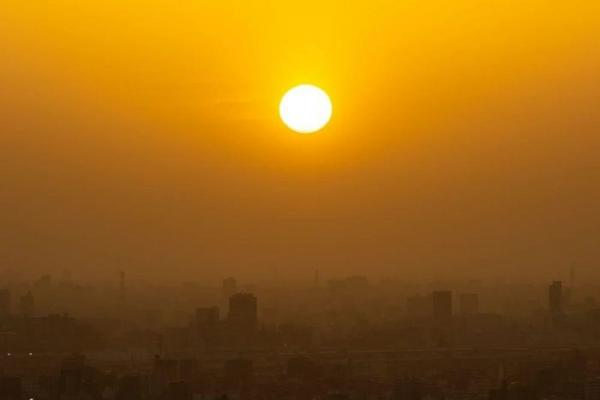
The WMO said 2023 was the hottest year on record on the planet, but the continued impact of the El Nino climate phenomenon in the first half of 2024 will risk setting a new temperature record this year.
According to a Vietnam News Agency correspondent in Paris, daily newspaper Les Echos quoted the World Meteorological Organization (WMO) as saying that 2023 will be the hottest year recorded on the planet, but the continued influence of the climate phenomenon El Nino in the first half of 2024 will risk setting a new temperature record this year.
It can be said that 2023 broke all temperature records when the planet’s average annual temperature exceeded pre-industrial levels (1850-1900) by 1.45°C.
WMO reiterated data provided by the European Copernicus Observatory, with a warning that the earth is approaching the +1.5°C limit, the dangerous level set by the Paris Agreement.
In a warning issued over the weekend, WMO clearly stated: “There is a 66% chance that the annual global average temperature will exceed pre-industrial levels by more than 1.5°C in at least one year from 2023 to 2027. ”
Head of climate monitoring and policy development at WMO, Omar Baddour, said that “if greenhouse gas emissions parameters remain unchanged, we will see a +1.5°C increase in warming.” annually by the late 2040s.”
These records can be explained by three parameters: the volume of greenhouse gas emissions, the El Nino climate phenomenon that started in the spring of 2023, and the eruption of the Tonga volcano in the Pacific, which has already begun. from the beginning of 2022, but its effects are still being felt today, especially the huge amount of water vapor released.
If this hot water vapor rises and cools in the stratosphere, it will create a greenhouse effect, contributing to global warming.
Even for the most experienced scientists, it is difficult to determine the exact contribution of each of these phenomena to global warming, but one thing is certain, the El Nino effect will reach peaks in January and will continue until Spring 2024.
Typically, after it peaks, this phenomenon has the biggest impact on temperatures, leading experts to say this year could be even warmer than last year.
This complex meteorological phenomenon affects all regions of the world but has very contrasting effects. “In the intertropical region, this is very evident with heavy rainfall and the risk of strong flooding in East Africa. On the contrary, in southern Africa or Brazil will face severe drought,” expert Omar Baddour explained.
The adverse impact on climate is very worrying because it will take many lives and leave unpredictable socio-economic consequences.
The world has not forgotten the record disasters in history, most recently the floods in Libya after Hurricane Daniel passed, killing more than 10,000 people last year.
To limit the number of deaths caused by these extreme climate phenomena, many countries have coordinated with WMO and civil protection organizations to gradually install warning systems and put them into use in places. Haven. But currently some countries still lack the resources to deploy these systems.
New WMO Secretary General Celeste Saulo affirmed: “The El Nino phenomenon is natural, coming and going from year to year, but long-term climate change is increasingly increasing due to human activities. .”
He called on the world to make more efforts to reduce greenhouse gas emissions, limit global warming as well as extreme weather events./