
The new report of the National Insurance painted a worrying picture regarding the expected depletion of the funds in 2036, instead of 2044. Dr. Michal calls, an expert in financing social security systems at the University of Haifa, explains in an interview with ‘Davar’ that the situation is worrying, but not lost. According to her, the problem of instability in the National Insurance has been known for years, regardless of this or that collapse date, and is caused by the Ministry of Finance’s refusal to address it. The solution she proposes is to increase the National Insurance contributions, which have actually decreased in recent decades, mainly those collected from employers.
What caused the contraction of the national insurance funds?
“In the near term, in the last five years there was a series of crises, such as the corona virus and the war, which increased spending on pensions without an adjustment on the income side. But these crises escalated a broader trend of many, many years, in which the flow of income over time develops more slowly than the flow of expenses.”
But there are years when the National Insurance ends up with a surplus.
“Unlike the government’s current budget, where we check how much we brought in in taxes that year and how much we spent, in insurance plans we look at the development of spending in the future, according to various assumptions. These are called actuarial calculations. We make assumptions about employment rates, the rate of aging, the type of families we have, and It’s not exact, but it’s a forecast that to a certain extent shows what the income and expenses will look like in a few years.”
And what created the long-term gap between expenses and income?
“The depth of the crisis lies in government decisions made starting in the mid-1980s, which reduced the National Insurance contributions. In our time, the whole world knows that the population is living longer and we need to make upward adjustments, and save more so that we have enough at retirement age for old-age pensions, for example.
“While in most OECD countries we see an increase in insurance premiums, in our country the state actually lowered them over the years. It reduced them by tens of percent, mainly for the employers, and imposed slight increases on the employees, but not to the extent that could balance the coffers.”
Income from employer contributions to insurance premiums in OECD countries as a percentage of GDP (from the research of Dr. Michal Kora)
“The problem is not the date of emptying, but that the state creates a state of distress”
Who benefits from the reduced payment?
“In the past, employers paid the health costs of employees, a “parallel tax”, which was completely abolished, and the rate of insurance premiums paid by employers also decreased. These decisions diverted the National Insurance Institute from a balanced channel, and even a channel of accumulation, to a channel where the National Insurance funds are slowly depleted slowly.”
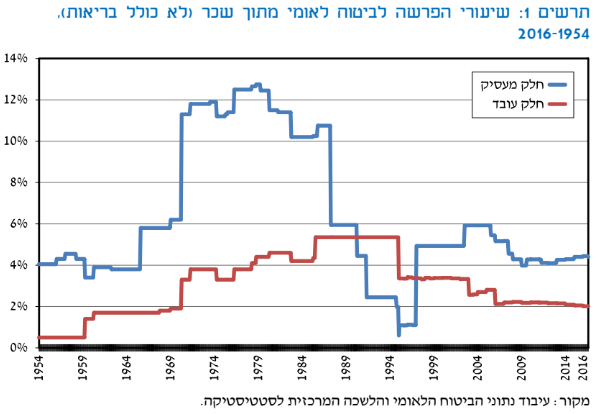
National insurance contribution rates from wages (from the research of Dr. Michal Kora)
13 years is enough time to fix?
“Adhering to the dates, whether it is 2044 or 2036, is not significant to me. It is a technical figure. Many countries have reserves that last only a few months, and these are not quixotic countries. In France, for example, the financial reserve is less than a year, and this does not endanger the faith of The French that they will receive old-age pensions, and their pensions are much more generous than the Israeli old-age pension.
“The problem is not the date of depletion, but that the state creates a state of distress, and does not give citizens reasonable assurance that the fund will be kept balanced. As of today, there is no definition in the law for a balanced situation, and there are no efforts on the part of the government to establish rules that will protect the national insurance in the future.”
If a certain fund in the National Insurance has been depleted, do the insured continue to receive the same amount?
“Entitlement to pensions is not related to the fund, but to the law that determines it. There are already funds that have been depleted – the unemployment insurance fund, for example. As long as the state does not decide to fundamentally change the law, then those who meet the criteria are entitled to the same pension, regardless of the state of the fund, because eligibility It is by law. Unemployment insurance also continues to be paid when the fund is empty. It is a social right, so part of the money comes from the Ministry of Finance, and part comes from reserves of other branches.”
“A pension fund gives a sense of security, but the money is invested in the capital market and there are crises in it”
Dr. Kora believes that a superficial discussion of the state of the National Insurance Funds may cause panic, instead of seeing its benefits and demanding that the government strengthen it. Understanding the differences between social insurance and private insurance. What is enshrined in law enjoys a thicker set of protections compared to private insurance.”
Why not rely on private insurance?
“You can finance the annuities in two ways, and there are also intermediate ways. People tend to think that if they have private insurance such as a pension fund, they will invest money and it will be available to them in the future. This is called ‘fully funded’, a fund whose assets at any moment are equal to its liabilities. This Gives a feeling of security, but it’s not real, because the money is invested in the capital market and there are crises in it. All over the world, pensions were cut in 2008 by dozens of percent. Those who retired that year were dramatically hurt. This is not my definition of a safe avenue.
And if the state produces a fully funded fund?
“Even when funds are not invested in the private market, let’s say when the state produces a fully funded fund, it does not guarantee that there will be enough money. Throughout history there have been situations that eroded the value such as inflation. The German fund, which is the first fund in history, was written off twice: once after World War I, And once again after World War II. The method of full financing seems apparently safe, but it is also prone to failures.”
What is the other method?
“Many countries have switched to a method called ‘current financing’, and not by chance. It is an intergenerational agreement, in which the generation that works finances the generation that has retired. There are those who claim that this is a form of pyramid scheme, especially on the American right. This method also has problems, but it exists from the middle The 1930s, over several generations without fail. I estimate that it is safer than many private insurances.”
What do you think of the struggle waged by the previous director general of the National Insurance, Meir Spiegler, to transfer control of the funds from the Ministry of Finance to the National Insurance?
“In my opinion, this is not the problem. The goal of the struggle was not really to take control of the funds, but to raise the cry of the National Insurance when the treasury ignores it and does not deal with the problem. Spiegler wanted to put pressure on the treasury in order to balance the fund in the long term, which has not happened yet.
“The alternative is to invest the National Insurance fund in the capital market instead of government bonds. This is a solution that the Treasury is currently opposed to, but it did make a move similar to the pension funds – canceling the designated bonds. The National Insurance remains on the government track, with a relatively reasonable return, more than is possible to accept in the capital market in channels with a similar risk.”
“The National Insurance contributions should be increased, and it can be offset by lowering other taxes”
Dr. Kora says that the solution to attrition is to increase the National Insurance contributions, but she emphasizes that this does not have to mean that the public will pay more taxes, for example through a parallel lowering of other taxes.
“It is possible not to increase the total tax burden on the citizens at all, but to decide that more is paid to the National Insurance and less to the treasury, and to offset the increase by lowering other taxes on the citizens. This is exactly the opposite trend to the current policy of the Treasury, which lowers the National Insurance premiums.”
And if the Treasury does not want to lower taxes? In the current budget, it was actually decided to raise the health tax and the VAT.
“The second option is to increase the general tax burden, with an emphasis on raising the national insurance premiums that employers pay. Employers in Israel currently pay the lowest national insurance rates in developed countries.”
What will happen if the issue is not addressed?
“It is very not worth neglecting the National Insurance. We need to pay attention to its vitality during the Corona period. I would insist, as a public, on raising the insurance premiums and making sure that the system balances out in the future. It is not worth reaching a situation where there is no choice but to cut rights.”
#order #balance #National #Insurance #insurance #premiums #raised #taxes #reduced
2024-03-21 10:22:39