

A true x-ray of the past are the paleoburrows, fossil lairs built by rodents, which inside preserve remains of feces, plants, insects, bones, pollen and seeds, among other organic elements that have been trapped in time.
Mainly in South America and the Atacama Desert, these records dating back up to 50 thousand years have been found, whose valuable information has allowed us to reconstruct past ecosystems and provide clues about how various species have been able to adapt to environmental and climatic changes.
In this context and in order to improve the conservation of these biological archives, highlight their importance, and promote new research in the area, a group of scientists from Chile, the United States and France published a recent study in the specialized magazine Trends in Ecology & Evolution.
Francisca Diaz.
Francisca Diaz, researcher at the Institute of Ecology and Biodiversity, IEB, and alternate director of the Millennium Nucleus of Applied Historical Ecology for Arid Forests, AFOREST, is one of the authors of this work, and who for years has explored rocky and arid sites in search for paleoburrows, thanks to which he has been able to carry out various investigations, such as reconstructing ancient vegetation from paleo DNA.
“The published study took eight years to prepare, and is a review of work with paleoburrows worldwide and, mainly, in South America. One of the main objectives is to draw attention to this type of records and update the scientific community, to show how new techniques allow us to provide answers to questions that could not otherwise be resolved,” explains the IEB researcher.
The doctor in Ecology maintains that the initial work with these records was fundamentally dedicated to describing what type of vegetation existed, through the leaves and seeds that were found in these samples. In this framework, the researcher also highlights the Chilean researchers Claudio Latorre (IEB) and Antonio Maldonado (CEAZA), for being pioneers in this area, and who gave rise to a large collection of paleoburrows in Chile.
“In Chile we have records mainly from the last 10 thousand years in Atacama, central Chile and Patagonia. And as we go further back in time, these archives are increasingly restricted to the Atacama, since arid places are where paleoburrows are best preserved. In fact, in this area we have managed to find records up to 50 thousand years old that we can date with radiocarbon,” comments Francisca Díaz.
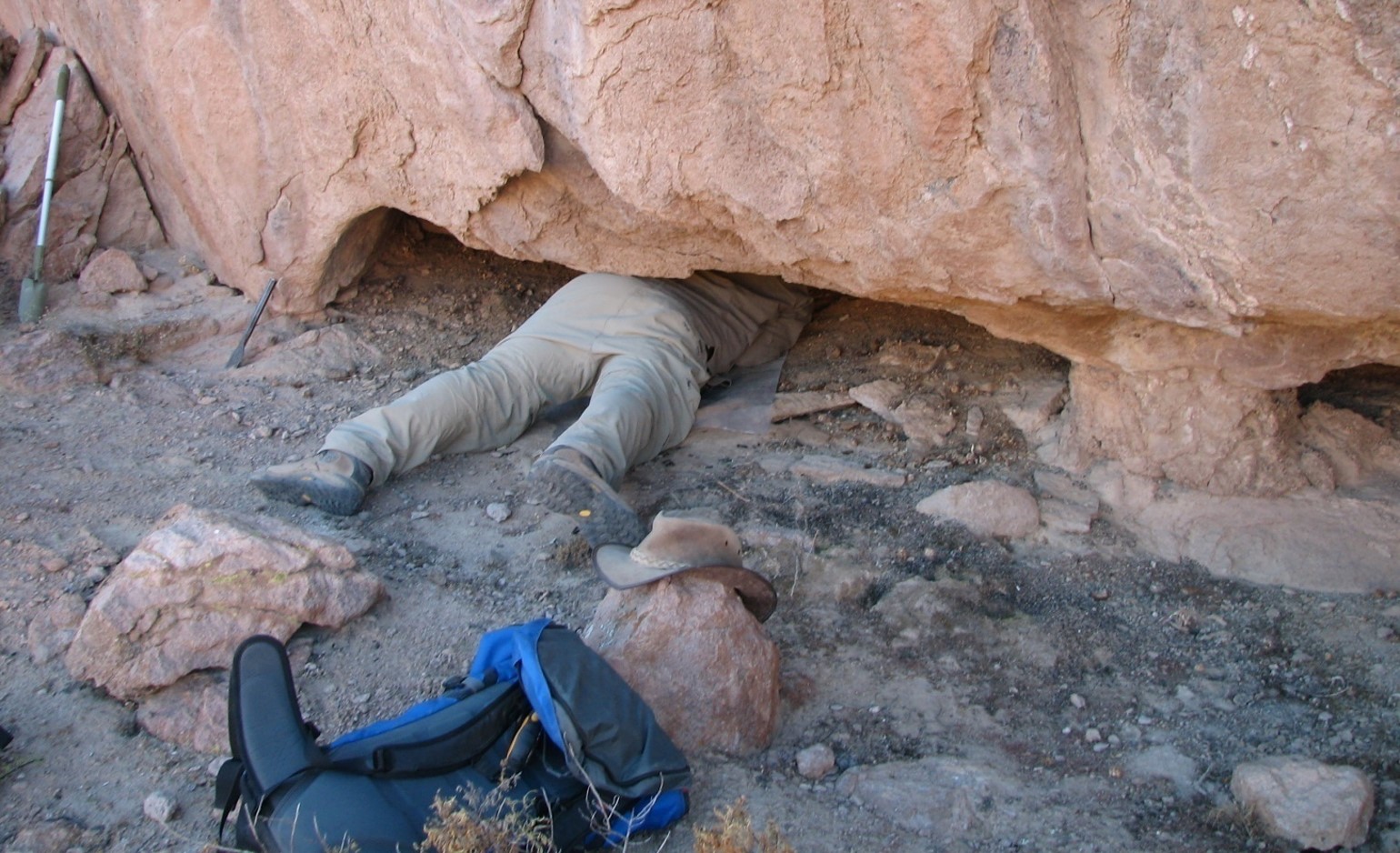
Claudio Latorre in paleocave.
Why is working with these biological archives so relevant and what new opportunities does it offer for science? The scientist mentions that one of the greatest advantages is being able to make an “ecosystem reconstruction, which can include plants, mammals, arthropods, as if it were a photograph of a time window.”
“Another relevant aspect is that the most recent paleoburrows allow us to have good baselines, to think about what pristine ecosystems were like before the industrial revolution or the great acceleration. Before we did not have access to see how we have modified the Earth system. And that is very key to understanding the Anthropocene.”
In this context, the scientist highlights some works that address these current problems, such as the effects of mining in the Atacama Desert, considering the presence of heavy metals in the burrows.
Despite the relevance and growth in research on these records, the work of Trends in Ecology & Evolution indicates that there is a decline, but that it is time to resume this line of studies.
“There was a time when the novelty of these records was lost, but now using the new paleogenomics tools, we can make an ecosystem reconstruction that is very novel. The use of paleo DNA opens many doors to reconstruct the past, and can also provide clues about the future in these arid ecosystems,” he comments.
The authors of the study point out that combining paleoecology with modern experimental studies is essential to understand the impacts of climate and environmental change. To achieve this, they maintain that it is essential to strengthen scientific collaboration worldwide.
On the other hand, the research recommends establishing regional repositories for paleoburrows, which could provide long-term access to researchers. To do this, they point out that it is necessary to collect and preserve more of these fossil records, preventing them from being lost as a result of changes in land use, the extraction of mineral resources, the increase in the frequency of forest fires and climate change.
“In this work we also propose that there be a collection protocol. Another point that we are interested in highlighting and that we hope can happen, is that these archives are treated and understood as part of our natural heritage, just as archaeological records are considered, those kept in museums,” details the researcher.