
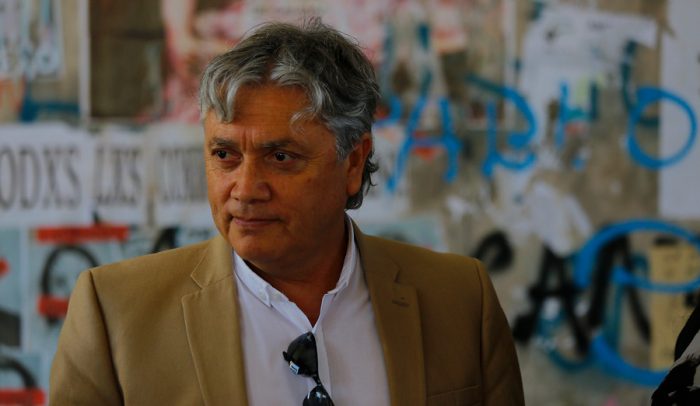
After 28 years in Parliament, 12 of them as a deputy and 16 as a senator, Alejandro Navarro Brain left public service in March 2022. However, he left with a firm slogan: “I am not going to abandon politics; “It is a lifelong commitment.”
Today, the Philosophy professor and father of seven children who tried to reach La Moneda in 2017, returns to the political arena and his name is emerging to be the only candidate of the ruling party in the elections for the Regional Government of Biobío, with the support of the Social Green Regionalist Federation (FRVS) and – as indicated by their own campaign team – the support of Democratic Socialism in the region and, potentially, of Christian Democracy (DC).
The president of the FRVS, Flavia Torrealba, told The counter that his party likes Alejandro Navarro as a public figure. “He has weight in the region” and he has been a respectable man, stated the official helmsman, so they would be happy to support him, both to try to convince the other parties of the Frente Amplio and to go to primaries.
In the FRVS they see the former senator as more moderate than he was a few years ago, especially in his position on Venezuela, something that currently – sources from the ruling party claim – does not overshadow the great interest he has expressed in Gran Concepción and Biobío. That is why they believe that he is the best option against the eventual re-election of the current governor Rodrigo Díaz Worner, former DC militant and accused in the “Lencería” aspect of the Covenants case.
In June 2023, after 15 months away from politics, Navarro broke his silence with a harsh look at the left and the Government. The former parliamentarian said from Caracas that he did not share Diosdado Cabello’s disqualifications against President Gabriel Boric, but affirmed that it was unnecessary for the President to correct the president of Brazil.
Back in Chile, although official parties such as the Democratic Revolution (RD) and Social Convergence (CS) have not yet made a definition regarding whether or not they will bring a candidate to the Regional Government of Biobío, Navarro would have the assured support of left-wing militants and center-left in the region.
Former socialist deputy Clemira Pacheco leads Alejandro Navarro’s campaign team and told this medium that the only option to strengthen democracy and the common good of the country is single candidacies and not thinking about the “smallness” that means looking at which party. He is the official candidate.
Clemira and Alejandro have known each other for years. The former deputy, who was head of Navarro’s campaign in the 1993 and 1997 parliamentary elections, mentioned that they have been talking a lot these days and that she is the one who has assumed the role of speaking with the ruling parties in the region to coordinate this new candidacy. The idea, she maintained, is that the former senator is the Government’s only candidate.
Despite the commitment of supporting Alejandro Navarro’s candidacy, Clemira Pacheco has a critical vision of regional governments. She commented that “we have missed out” on the opportunity to have better authorities that contribute to the decentralization of the country, due to the lack of powers of the governors, an issue that she is pending, especially after the uncovering of the Covenants case. In that sense, she also urged President Boric to make a proposal that once again addresses the issue of powers and the regional budget.
Regarding the current regional governor, former deputy Pacheco commented that, although the Prosecutor’s Office is in charge of clarifying his involvement in the Covenants case, he has to assume his political responsibility as head of Gore. “If he doesn’t take over, it’s no good,” she said.
Asked about the support that Navarro would have among the ruling party, the named strong woman of the PS – although she no longer officially militates but maintains strong ties with the left in the region – stressed that this week she will hold a series of meetings with different regional parties, including the DC.
Sources close to the leadership of the phalanx told The counter that, indeed, some have raised Navarro’s name as a possible candidate for the Regional Government. However, other possibilities are also being considered in the DC, such as Bachelet’s former Minister of Education and former mayor of Biobío, Martín Zilic.
Let us remember that, facing the municipal elections in October that will be held in parallel with the regional ones, the Christian Democracy ratified its will in agreement with the ruling party for single-person candidacies, although it left the issue of regional governors pending.
Former senator Navarro has not issued public statements nor responded to calls from The counter. His last publication on social network X is from March 10 and in it he shared a questioning of the current governor Díaz and the Gore Biobío agreements with the ProCultura foundation.
Opposition and uncertainty surrounding the re-election of Governor Díaz
The Electoral Service (Servel) established the deadline until April 10 for the presentation of the registrations of the pre-candidates, marking March as a crucial month to define the criteria of the agreement between the left and center-left forces. Meanwhile, opposition parties are also defining the names they could nominate in a primary or in next October’s elections.
Currently, at least three people have expressed interest in competing for a spot on the regional ballot, two of them confirmed by their respective parties. Among them are Luciano Silva, a professor from Tomé and former member of the Constitutional Convention for the Social Christian Party, and Fernando Peña, former Seremi of Education in Biobío during the second Piñera Government, who previously was a member of the UDI and is now a member of the Republican Party.
However, uncertainty persists around the current governor Rodrigo Díaz. His communications team indicates that re-election is a possibility, but that no decision has yet been made in this regard nor has a date been set to do so.
In 2021, after resigning from the DC, Díaz Worner ran as an independent for governor of Biobío, achieving victory in the second round. Currently, his name would be being considered by an eventual coalition made up of Democrats, Yellows and the People’s Party.
Rodrigo Díaz expressed to the regional media Know that “I am very grateful both to Deputy Joanna Pérez (PDG) for the generous words she has had about me and also to Mr. Eduardo Jara (Amarillos) who also expressed very generous words regarding me and, by the way, when I have to “I will make a decision publicly and communicate it publicly.”
Likewise, Díaz emphasized that “I am not afraid of elections, I competed for the job of regional governor outside of all the pacts, I collected signatures in a pandemic, when people had to be taken to the notary’s office to sign. Therefore, believe me, I am not afraid of either the primaries or the elections.”
It is worth mentioning that Amarillos for Chile is constituted as a party in the regions of Los Lagos, Los Ríos, La Araucanía, Ñuble, O’Higgins, Maule, Valparaíso, Coquimbo, Atacama, recently in Biobío and “we are working in Santiago,” said the deputy and president of the community, Andrés Jouannet.
Navarro’s controversial political path
In his youth, Alejandro Navarro faced economic difficulties that forced him to leave his Geography studies at the Catholic University of Valparaíso to work. However, he continued his education in Philosophy Pedagogy at the University of Concepción, where he stood out as a student leader during the last years of the dictatorship.
In 1994 he was elected deputy for the Biobío Region, serving for three consecutive terms, until 2006. In January 2009 he founded the Broad Social Movement (MAS), the same year in which he was proclaimed as a pre-candidate for the Presidency of the Republic. He resigned from said party in 2016 to join País, a community that proclaimed him as its candidate for the Presidency in 2017.
He entered the Senate in 2006, motivated by – as he mentioned in statements to the Upper House communications site – frustration over the rejection of a bill he had proposed to include driver’s education in the school curriculum. Throughout his legislative career, he focused on projects in matters such as the environment, housing and labor.
But his career has not been without controversy. In 2007, it emerged that several of his bills contained passages copied from the Internet, including one on nanotechnology and another on autism. That same year, during an unauthorized demonstration, Navarro confronted the police, resulting in an altercation recorded by the media.
In 2012, he suffered a serious snowmobile accident that left him with multiple injuries and from which he managed to recover. And in 2022 he was removed from his position as president of the Senate Human Rights Commission due to his positions on Venezuela.
Also remembered is the episode in which, during the 2017 presidential campaign, defiantly and throwing coins on the table, Alejandro Navarro questioned Sebastián Piñera during the ARCHI debate. This, for the second loan that BancoEstado granted to finance the campaign of the deceased ex-president. “It is hateful that BancoEstado lends money to a billionaire,” said the candidate of the then País party.