
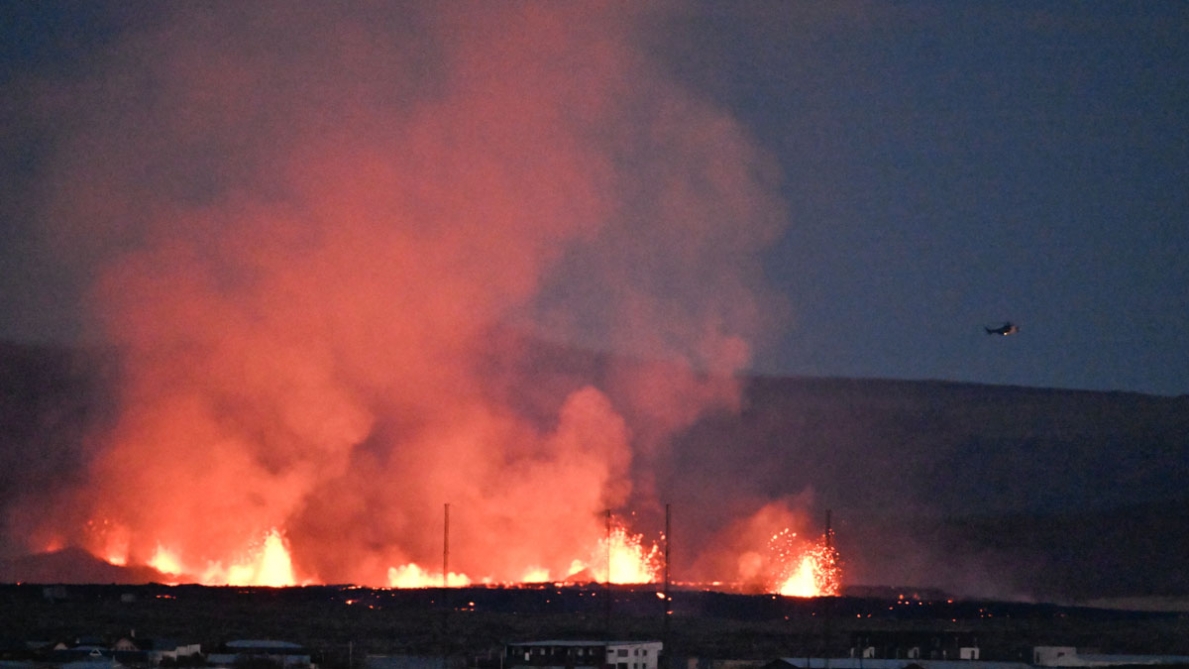
Lava from a volcano that erupted on Sunday near the fishing port of Grindavik in southwestern Iceland set fire to three houses in the town, whose residents had been evacuated a few hours earlier.
This is the fifth volcanic eruption to have occurred in Iceland in almost three years, the previous one having occurred on the evening of December 18th in the same area. But the lava had not reached the homes for 51 years. Seismic activity had significantly accelerated overnight and the few dozen residents resettled in late December in this small town, located about forty kilometers southwest of Reykjavik, were evacuated around 3:00 local time ( 4:00 in Belgium). . ).
Two fissures then opened, one around 8am about 400 meters from the city and the other at midday on the edge of the first houses, according to the Icelandic Meteorological Office (IMO), spewing large flows of bright orange lava.
In mid-afternoon the first two houses were hit by burning lava and immediately caught fire, releasing large plumes of black smoke, according to surveillance camera images broadcast by Icelandic public television. Subsequently, a third house was also burned.
“In a small town like this, we’re all like family, we all know each other like family, so it’s a tragedy to see this” Sveinn Ari Gudjonsson, 55, a Grindavik resident who was evacuated in November, reacted to AFP. “It’s unreal. It’s like watching a movie”adds this man who works in the fishing industry.
“Black Day”
Speaking at a press conference, Icelandic Prime Minister Katrin Jakobsdottir complained “a dark day for Grindavik and for all of Iceland”. “But the sun will rise again”, he promised. “Together we will face this trauma.”
Grindavik, which has 4,000 inhabitants, was evacuated on November 11 as a precaution after hundreds of earthquakes caused by the movement of magma under the Earth’s crust, a precursor to a volcanic eruption.
These earthquakes damaged the city, creating large cracks in streets, homes and public buildings. “The last time lava reached homes was 51 years ago”recalled President Gudni Johannesson during a rare speech on public television. “We hope that the situation calms down, that everyone can return but (…) anything is possible. We must remain confident”He added.
Shortly after the eruption on December 18, residents were allowed to return to Grindavik briefly and then permanently from December 23, before being emergency evacuated on Saturday night. Only a few dozen residents had returned to their homes. Authorities issued an order on Saturday evening to evacuate the city by Monday due to seismic activity and its impact on existing crevasses in the city. So they had to pick up the pace overnight.
Disappearance
This decision also follows the death on Wednesday of a 51-year-old Icelander who was working in a private garden when the ground suddenly gave way under his feet.
The man, who has not been found, fell more than thirty meters into a crevasse. The authorities are closely monitoring the Svartsengi geothermal power plant, located in the same area and which supplies electricity and water to around 30,000 inhabitants of the region, and whose plants are protected by a wall.
Until the March 2021 eruption, the Reykjanes Peninsula, south of the capital Reykjavik, had been spared from eruptions for eight centuries.
There have been four more, in August 2022 and July 2023, on December 18, 2023 and this Sunday morning, a sign, for volcanologists, of a resumption of volcanic activity in the region.
Four days after the Dec. 18 eruption, authorities said volcanic activity had ceased but could not say whether the eruption was over, due to possible underground lava flows. Thirty-three volcanic systems are considered active in this country of fire and ice, the most volcanic region in Europe.
2024-01-14 21:00:00
#Volcanic #eruption #hits #port #city #houses #burn