
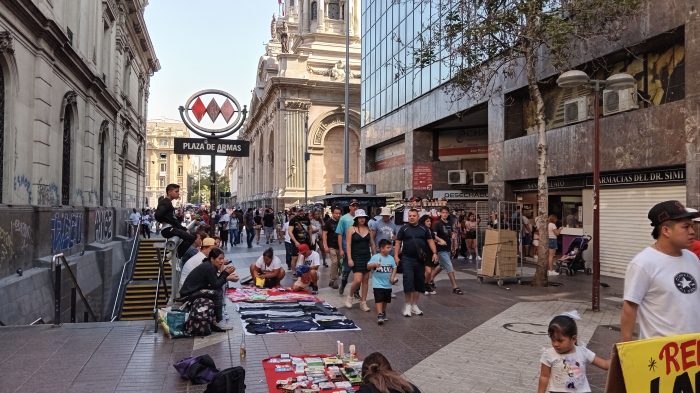
The Tourism and Commerce Guild Association of the Historic Center of Santiago (TUCHS) appealed to the authorities to recover the center of Santiago, affected by crime, illegal trade and the migration of companies to the eastern sector.
Although the association has carried out joint work with the mayor’s office led by Irací Hassler, the president of TUCHS, Consuelo Pfeng, points out that to build a Center plan “you need leadership, which translates into a face, a proposal, a commitment and measurable actions over time, and this is what we expected from our conversations and dialogue with the mayor and her cabinet.”
“Today, tourism and commerce are not on the agenda or in the mayor’s speech, which worries us, because the center is not just about votes, but about a symbolic place for the city, even for the country and our history. As we constantly repeat, ‘if you lose the center, you lose the city.’
Survey
To have a diagnosis of the situation, the TUCHS previously carried out a survey that allowed 479 surveys to be carried out on businesses in the Historic Center.
The objective was to collect data from counterparts, possible partners, and perception issues regarding public space problems.
The project was carried out on January 16 and 17, which had the support of the Enac Technical Training Center and members of the union (Hotel Plaza San Francisco and Hotel Gran Palace).
The largest number of stores surveyed are in the clothing sector, followed by restaurants and a variety of others.
When asked what issue they consider most important to work on in the historic center in 2024, 66.9% considered that the priority problem was security, 26% responded that economic reactivation and finally 7.1% indicated that tourism and heritage was the topic to be addressed.
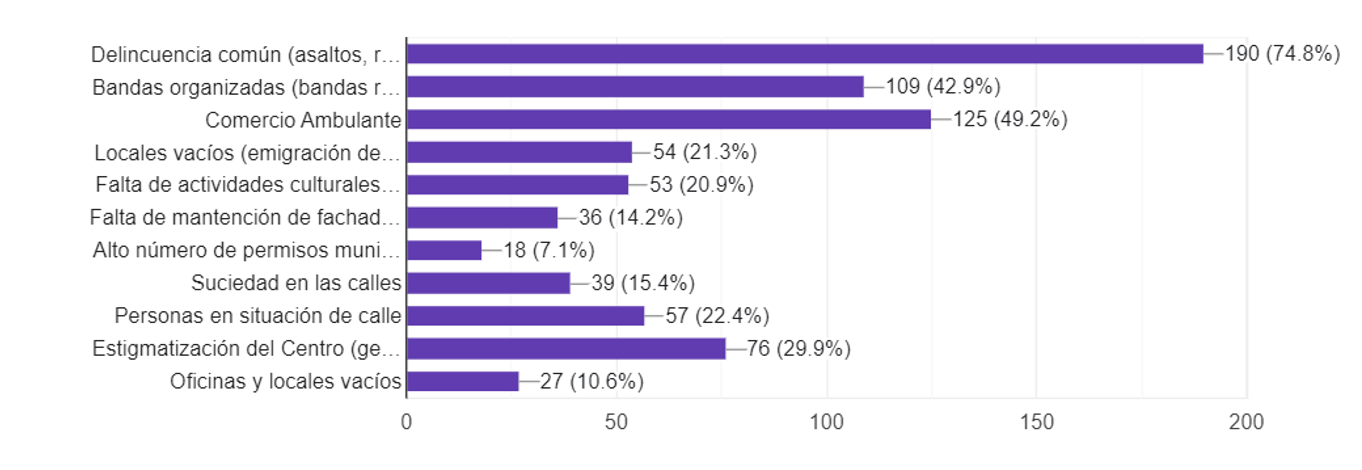
Specifically, of the problems that affect the Historic Center, those that the respondents consider to be the main ones are common crime, organized gangs, street commerce and stigmatization of the Center.
77% of businesses have been directly affected by the problems mentioned in the previous point, and more than 80% of them amount to robberies and assaults.
Likewise, the institution that businesses believe is primarily responsible for managing and solving these problems is the Illustrious Municipality of Santiago.
Last November, Hassler assured that surprise robberies had decreased by 45% in Santiago during his administration, and that robberies against students had also decreased by 45% and crimes and incivilities by 38% in the República and Meiggs neighborhoods.
However, for the president of TUCHS, “it is not enough that crimes have decreased, which may also be due to hopelessness due to the low results in response to complaints, but the perception of insecurity affects the development of tourism and commerce.”
“Today we have Chilean and foreign tour operators who have blocked the center as a destination, due to the impossibility of ensuring a satisfactory route. Added to this are the problems with garbage management, the complexity of the situation with people who spend the night on the streets and the deterioration of spaces such as walks and streets within the center,” he denounces.
In his opinion, a bigger problem can be added to this, which is the emigration of large downtown offices. Of the 290 companies with more than 1000 m2, only a third remains, which in turn affects the occupation of space and the local economy, which is in turn reflected with the closure of small businesses and smaller offices. .
Causes
When asked about the reasons for these problems, Pfeng believes that it is mainly due to the lack of strategic plans in the center.
“The problem of historic centers is not only in Santiago, it occurs around the world. However, there are positive experiences where public and private actors and social organizations work from building trust to develop joint strategies,” she says.
“Today the configuration of work, and the population changed for the center. Teleworking, the economy and social problems are not foreign to what we can see today. However, due to this same situation, the urgency is today, and not wait until in 20 more years, when it is too late, for us to be able to work together and develop the measures that are needed and that address the problem in its entirety.” .
Authorities
Regarding the authorities, specifically the Municipality of Santiago, the president of TUCHS estimates that “there is a lack of strategic focus towards the center.”
“Today we have a limited takeover plan (civil guards in black). We know the program because we provide our infrastructure through hotels, for the rest of the coping agents. This program works relatively well, we have seen a clearance in downtown walks, but it is incredibly limited for the historic center area and does not even consider tourist routes. Today we continue with the problems in Santa Lucía, Alameda, and the Puente sector, problems that are serious, where the existence of organized gangs is known,” he notes.
He adds that regarding illegal trade in these areas, operations are carried out which are infrequent and do not have a major impact.
“Today, when the entire city is not yet operating normally for holidays, we see how illegal commerce continues to take over these red spots in the center on a daily basis,” he says.
Proposals
TUCHS has a series of proposals to address these problems.
“Through our ‘Let’s Focus’ plan, we have proposed a series of initiatives in the axes that we have defined as priorities: Security, Economic Reactivation, and Tourism, Culture. Each of these axes has management projects, review of ordinances to facilitate the maintenance of current businesses, review of incentives to attract investment to the center, programming of cultural products for tourism, recovery projects for facades and points of interest. , promotion of the tourist attractions of the center, service chains, meetings of international experiences of recovery of centers, studies for commerce and tourism, among others,” he assures.
Pfeng adds that all these lines and initiatives are conceived in line with a strategic plan.
“For this reason, in recent weeks we have been in conversations with academics and experts on the subject, who tell us that the existence of a master plan is vital, where various actors participate in its development and a precedent is set to reflect that It is what we want for this center and this city in the coming years,” he explains.
Work with the Municipality
The truth is that there has been joint work between the TUCHS association and the Municipality, according to the mayor’s office.
In fact, the Municipality of Santiago, through the Subdirectorate of Local Economic Development, has had close ties with the Tourism and Commerce Association of Santiago (TUCHS) since its formation last September.
“This good relationship has translated into the installation of a permanent work table and joint collaborative actions, to reactivate the local economy of the Historic Center, in spaces such as Paris – London, Paseos Ahumada and Estado, sectors that have been energized with the holding entrepreneurship fairs, installing stamps with offers and activities to promote commerce on relevant dates, for tenants,” the municipality indicates.
The mayor’s office added that, also, and due to the climatic contingency this summer, the Municipality arranged new climatic shelter points in nine commercial galleries, so that tourists, merchants and the general public can walk and shop and, in turn, hydrate. and rest in these spaces.
The Municipality of Santiago, in addition, has deployed different strategies to recover public spaces, clear street commerce and put an end to the mafias that had taken over the center and that now, with the establishment of the Santiago Detachment and the takeover agents, have been eradicated from the historic center, which reduced surprise robberies in the Historic Center (main walks in the center of Huérfanos, Estado, Ahumada) by 45% and decreased the feeling of insecurity in the sector by 22%.
“Finally, from the municipality we hope to continue generating public-private alliances to work together for a more prosperous and safe commune, without exclusions,” they comment from the mayor’s office.
Unanswered
Pfeng confirms that the union, since its inception, has been available to talk, participate in municipal activities and meetings.
“Our conversation with officials has been continuous, and we understand that each action that is carried out is largely due to the will of all of them,” he comments.
In fact, the mayor, through her chief of staff, signed a public commitment with TUCHS in an open event at the municipal theater on October 3, where she commits to working for the recovery of the Historic Center.
However, Pfeng accuses that there have been commitments that have not been fulfilled.
“We have held meetings with his chief of staff, and with cabinet advisors where we agreed on a series of commitments that have not been developed. In recent weeks we have reminded the chief of staff, Don Marco Barraza, and his advisor Macarena Godinez of these commitments, and this was not answered in any way, nor were the direct emails to the mayor about serious matters that occur in the Paris neighborhood. London, such as the burning of the façade of the Plaza Hotel London by a homeless person. And in this way we continue waiting for the promised reactivation table, as well as a delegate for the center, a plan for the reactivation of commerce, or the necessary tourism planning,” concludes Pfeng.