
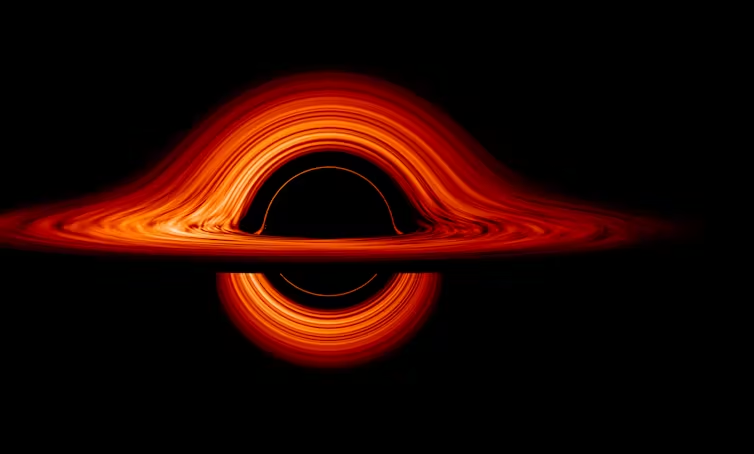
What would it be like to fall into a black hole? What would we observe when we approached it? And even more, what final destination would this fascinating object have in store for us?
Now, thanks to powerful simulations carried out by NASA, we have a clear visual perspective of this phenomenon. To do this, the researchers used the Discover supercomputer at NASA’s Climate Simulation Center, handling a huge amount of data (around 10 terabytes, equivalent to 10,000 copies of the Encyclopedia Britannica).
To give us an idea of its high processing speed, Discover completed these simulations in about five days, compared to the decades of processing that a typical laptop would have used.
The supermassive black hole
These simulations begin with a camera located about 640 million kilometers away, slightly less than the separation between the Sun and the planet Jupiter, to progressively approach a supermassive black hole of 4.3 million solar masses (similar to the monster located in the center of the Milky Way, Sagittarius A*).
During its fall, an intrepid astronaut would observe in detail a flat cloud of hot, bright gas that surrounds the black hole (and that would serve as a visual reference): the accretion disk.
Furthermore, as it approaches the event horizon, it would distinguish bright rings of light (or photon rings) formed by beams of light that orbit the black hole several times. To top it off, a starry sky, as it would be seen from Earth, would complete this impressive scene.
Approaching the photon ring
Let’s imagine then that our astronaut jumps over the black hole, recording his fall with a camera, while the rest of the crew observes the feat quite far from the scene. At the very moment of the jump, the astronaut and the crew would have their watches perfectly synchronized.
On his way towards the unknown, our traveler would gain more and more speed (even close to that of light) and would observe the accretion disk, the rings of photons and the night sky becoming more and more distorted (even forming multiple images, perhaps as seen in the simulation).
What’s more, the brightness of the accretion disk and the cosmic background stars would increase considerably when the astronaut looked in the direction of travel, due to the well-known Doppler effect.
On the other hand, the clocks of the crew and the astronaut would no longer be synchronized, with the latter’s clock being set back about 12 minutes. That is, time would pass more slowly for the astronaut than for his companions.
The surface of no return
“Abandon all hope, you who enter here.” It is the inscription that Dante Alighieri describes on the gate of hell in the Divine Comedyand which fits very well with the definition of the event horizon of a black hole.
Indeed, about 11 minutes later (on the astronaut’s clock), our traveler crosses the surface of no return. Although he could still receive images from outside, no signals he sent within the event horizon would reach the crew.
The mere fact of passing through the event horizon of a supermassive black hole would not, in principle, entail any trauma for the astronaut. The problem would come only about 12.8 seconds later, when his death would occur due to spaghettification. This is because the gravitational pull at the end of an object closest to the black hole is much stronger than that at the other end.
In this sense, although it may seem paradoxical, a stellar black hole of about 30 solar masses (like the recently discovered Gaia BH3) would be even more problematic than a supermassive one, since the tidal forces would be more intense and the astronaut would be destroyed even before to reach the event horizon.
And what would the rest of the crew observe? He would simply say that his daring companion has never crossed the surface of no return. In other words, it would take the astronaut “infinite time” (on the crew’s clock) to cross the event horizon.
A flight rapid through the event horizon
But we would also have good news, as long as it was able to modify the initial trajectory of its launch into the black hole. In that case, it would approach the event horizon (without passing through it) and then escape to safety.
So if our astronaut flew a round trip that was about 6 hours long (on his watch), he would return 36 minutes younger than the rest of the crew. This is because time passes more slowly near a very intense gravitational source and when moving near the speed of light.
The rejuvenated traveler would survive, he would not suffer an episode as traumatic as the previous one but, without a doubt, it would be an exciting experience.