
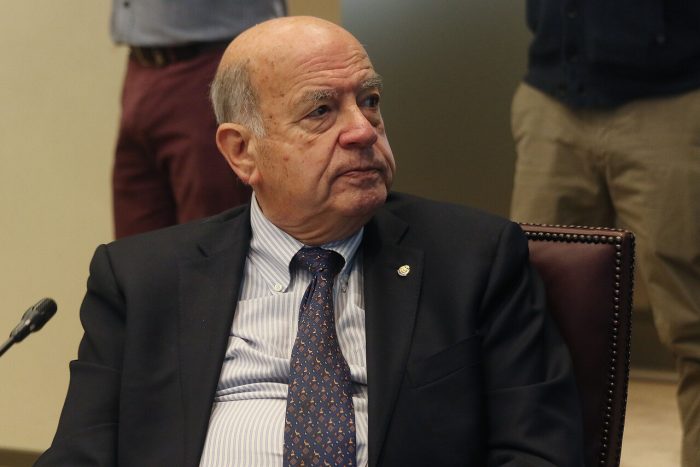
The former Minister of the Interior, José Miguel Insulza, addressed the crisis that triggered the departure of the former general director of the PDI, Sergio Muñoz, and the institutional impact What does it mean for La Moneda to have a beheaded civil police force?
“I would say that more than the real, effective, material damage, the damage to the image is always bad, always negative. The PDI had also been outside of any type of scandal. That is, in recent years there have been problems with the Carabineros and it has been difficult for them to recover, but the PDI had not been the object of this type of thing. When one met, for example, with the PDI to discuss new bills, and asked how this affected them, they said we are absolutely within the law, we have no problem,” he noted.
In conversation with the Mesa Central program, Senator PS did not want to venture the real impact that this case could have on the police institution. “It’s hard to say. For example, the problems of Pacogate, or what happened with the Mapuche community member Camilo Catrillanca, affected Carabineros very strongly. But the information that the general director was going to be formalized did not cause anything, it was not reflected in the polls, so to speak, so it is a little difficult to know. I think the PDI has reacted well. In fact, the doors were absolutely opened, there was no difficulty, no one asked for any special treatment, and I believe that we can move forward.”
However, Insulza reiterated that beyond the judicial implications, the problem is the image of the institution. “The impact on the image, unfortunately, in police and military institutions, sometimes generates damage to the institution that prevails over the presumption of innocence.”
When asked about President Gabriel Boric’s change of opinion regarding the use of the military in some security functions, Insulza warns of the need to distinguish the framework under which the Armed Forces would provide that help.
“Yesterday’s article in El Mercurio by Jorge Correa Sutil, my former Undersecretary of the Interior, was really excellent. In other words, he says exactly when it can be done and when it can’t. He clearly questions this idea of taking the military out on the streets, to patrol the streets, because that is not what they are for. But he does recognize that they could be used for some things. I think the president was thinking something similar. He was thinking, for example, and I believe that this is an issue that has been pending for quite some time, which is the issue of critical infrastructure. Because precisely, Jorge Correa, among the cases that he puts, is when the police forces are clearly overwhelmed by armed violent groups, and the second is when there is a critical infrastructure problem,” he indicated.
Finally, the senator warned about the electoral factor that crosses the debate on security. “That necessarily inspires some of the mayors who go out to ask for soldiers in the streets. Which in reality is making others pay the cost, because they know that neither the military nor the government will be available to approve an outing with long weapons on the streets. But as it is what the people want, and that is where these real problems occur, problems where the opinion of the government has to weigh much more strongly.”
“I remember when the death penalty was abolished in Chile, we had a survey that showed that more than 60% wanted there to be the death penalty. But President Lagos decided to abolish the death penalty and we faced it, and it was approved in Congress. Because everyone was very clear that this was a solid government, that there was also a cost to be paid for being against the government. But today it seems that some believe that there is no cost to being against the government,” he stated.