

Everything points to winning the elections of 2024 and the presidential election of 2025. The controversy of rapprochement or not between Chile Vamos and Republicans. How to settle the presidential candidacy and face the municipal and gubernatorial candidacy. The Yellows and Democrats factor. “A specific basis” to land a common programmatic proposal, avoiding value and identity issues.
Hugo Guzman. Journalist. “The century”. Santiago. 4/1/2024. In the opposition, private conversations about analysis and projections, meetings in homes and offices, meetings in restaurants, breakfasts are very active. There is a lot of topic. And a lot of challenge.
Characters such as José Antonio Kast, Sebastián Piñera, Evelyn Matthei, Javier Macaya, Gloria Hutt, Rodrigo Galilea, Arturo Squella, Gonzalo Blumel, Paula Daza, Cecilia Pérez, Jaime Bellolio, Karla Rubilar, Isabel Plá, Juan Antonio Coloma, are participating in meetings open and private to reflect on the results of the plebiscite, the current political situation, the situation of the Government, the tactics of the moment, but also, and perhaps strategically, defining the paths forward, which has as a first knot what to do with the sector alliance policy and specifically and how to address the link between Chile Vamos (UDI, RN, Evópoli) and the Republican Party.
Along with coordinating a strategy against the Government of President Gabriel Boric, we are reflecting and discussing how to face the municipal and gubernatorial elections in 2024 and the presidential and parliamentary elections in 2025.
In these matters there are always groundwater and particular interests, but what is visible indicates that something central is to resolve the coordination and possible agreements between the traditional right and the extreme right, and together with an agreement or national/global political and programmatic, see how to land more specific electoral pacts.
None of this flows linearly or evenly, frictions, pitfalls and skirmishes always appear. But the main strategists are worried and aiming for bigger words.
Will there be marriage?
What is clear in these weeks is that in Chile Vamos there are two very defined positions: one for agreeing with Republicans and the other for maintaining distance. The same thing happens in reverse.
These two expressions occur in the Independent Democratic Union (UDI) and in National Renewal (RN) and do not seem resolved to date.
“The hardliners” of the UDI and RN insist that an alliance with the Republican Party must be achieved, for electoral purposes but also to fortify a political project taking into account new national and regional realities.
They maintain that the movement of the right is not primarily “towards the center”, but rather towards strengthening the identity and organization of the conservative sectors.
And the “more flexible” or “liberal” sectors maintain that it is inconvenient to go “to an extreme” and agree “at all events” with the Republicans. They think that this blurs “the center-right project.”
In Political Evolution (Evópoli) there is a decision to distance itself from the extreme right and, at most, make pacts by omission in the elections.
The Yellow and Democratic groups enter this framework, which seem close and in tune with Chile Vamos, but very distant from the Republicans.
Gloria Hutt, president of Evópoli, established that “we are very interested in strengthening the alliance towards the center,” speaking of Yellows and Democrats. She herself indicated that the only viable agreement with Republicans is by electoral omission in certain places, that is, not getting in each other’s way.
The leader of Evópoli, Hernán Larraín, said in an interview in La Tercera that “there is a part of Chile Vamos that sees Republicans as an ally,” and then warned: “That is a serious insecurity, because the Republicans project is hegemonic.” .
Within the Republican Party, opinions are expressed regarding maintaining the identity of the sector, not mixing with a right that they consider weak and that makes concessions to the ruling party, and reinforcing their own vote that has paid off for them.
Another segment, which would be a minority, points to the need to have good electoral results, ensure victory in the 2025 presidential election and learn to relate, above all, with the UDI and RN in the political hustle and bustle.
In meetings and conversations it is known that all the opposition parties have analyzed what happened with the victory of the far-right Javier Milei in Argentina and how he agreed with the more traditional right and the macrism (current of former conservative president Mauricio Macri).
Several leaders have pointed out, and it is known that it is a topic of conversation at dinners, breakfasts and meetings, that an issue to be resolved is how to channel a political/programmatic agreement, as a basis for a municipal, regional, parliamentary and presidential electoral agreement.
Those who are in favor of the alliance maintain that the way to achieve this is “a specific basis”, that is, including economic, institutional, social, sectoral, very precise, management, governance issues, and that for this “there is meat in the grill”.
That means leaving aside matters of identity, values and more substantial differences.
But the “hardest” and “most doctrinaire” groups warn that this is unviable and that it would be very difficult to make programmatic bases compatible between the traditional right and the extreme right.
Luis Larraín, executive director of Libertad y Desarrollo, said in ExAnte that after the plebiscite “one good thing that remained for the right is that you can work with people like the Democrats and the Yellows, who have shown that they are capable of crossing the Yes pond.” and No. And with them we are united by a fundamental issue, which is loyalty to the institutions of democracy.”
However, there are views like that of Pablo Longueira, former president of the UDI who continues to have a certain influence in that community. In an interview in La Tercera he expressed that “if Chile Vamos does not have the capacity to have its own project and strengthen political structures, they can be perfectly subsumed in an election by Republicans.”
The candidacy for the senior seat of La Moneda
Another issue is the sector’s presidential candidacy. Some leaders hope that by the end of 2024 this will be resolved and everyone knows that in the first quarter of 2025, due to the legal deadlines for primaries and registration, the issue must be resolved.
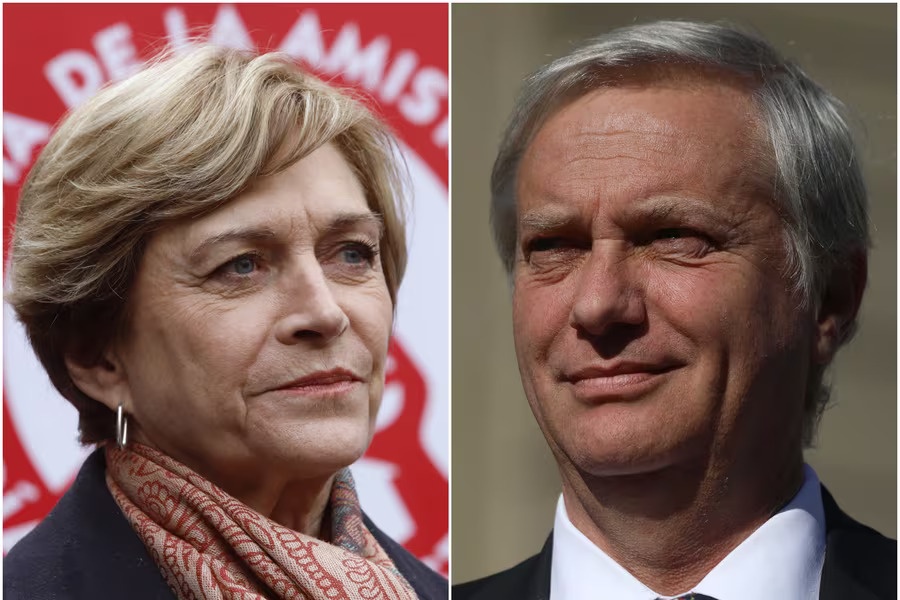
There are several names running, with Evelyn Matthei (around 25% in polls) and José Antonio Kast (with an average of 15% support) leading. Others like Rodolfo Carter (with a tough defeat for A Favor in his commune) and Sebastián Piñera (analysis points to enormous wear and tear) seem ruled out.
Improbable positions like those of Ximena Rincón from Amarillos or Rojo Edwards and Axel Kaiser from the extreme right (even if they run alone, on a different track) are seen.
Beyond names, in the opposition there is a conviction that the presidential election is won. It is discussed in all its circles and spaces.
Kast’s phrase that “the left is going to lose the next election, because it is going to bear the disaster of the current Government,” makes sense on the right and the extreme right.
At the same time, they conclude that candidates such as those of Camila Vallejo, Carolina Tohá, and Michelle Bachelet are winnable, who are the ones that have the most impact on the ruling party.
Furthermore, there is confidence in a base of 40% of votes that could be increased by promoting one’s own option and betting on weaknesses/errors/fragmentations in social democracy, progressivism and the left.
In any case, the senator of Evópoli, Luciano Cruz Coke, said in El Mercurio that “I am scared by the division of the opposition vote and this drunkenness ( ) in terms of thinking that we have won the election.”
Of course there are knots to untie. Not everything is so fluid and simple.
As if the Republicans would be winning the position of not going to primaries, that is, taking Kast to the first round. While Chile Vamos aspires to resolve the issue in a primary.
Something that threatens right-extreme right primaries is that there is a conviction among Republican experts and figures (it is said that in RN and UDI as well), that it is electorally convenient to have two candidates.
However, in counterpoint, there are those in the opposition who maintain that victory must be resolved in the first round and that there would be conditions for this. And, at the very least, he would advance to the second round in a good position, in a position to win.
Here comes a high-intensity tug-of-war.
Another issue to unpack is how a common presidential/programmatic proposal is constructed.
This has to do with the debate of whether or not it is possible to achieve the construction of an agenda of defined points and leave aside value and ideological differences between Chile Vamos and Republicans. It appears as something titanic, but a certain pragmatism, creativity in the elaboration of a text and openness on both sides could trigger a common document.
The elections in sight
Much of what is going to happen in the opposition has to do with how it will resolve a possible alliance or not, in view of the election of mayors, councilors, regional councilors and governors.
In the most strategic line, there are segments of the UDI, RN and Republicans who propose that this is the opportunity to finalize a political and electoral alliance.
However, there are also groups of these communities that are not in favor of such a marked and defining alliance, to which Evópoli, Amarillos and Democrats are added.
Along these lines, “a pact by omission” could be imposed and precise agreements reached regarding several communes throughout the country where Republicans do not enter into a fight with parties from Chile Vamos.
The above would materialize, for example, in the cases of mayors of the upper neighborhood of the Metropolitan Region, in communes in the south of the country and in definitions of how to face the elections in places such as Santiago, Valparaíso, Recoleta, Temuco, Valdivia, to defeat to official communal leaders.
In that, according to conversations about which something is known, there are objectives such as increasing the number of governors of the sector, maintaining mayoralties and winning in others considered emblematic, increasing the number of councilors and regional councilors.
The most optimistic in the opposition believe that this is possible in a coexistence between Republicans and Chile Vamos and with agreements with Yellows and Democrats.
It helps that the Republican Party indicated, informally, that they would not be running candidates in all the communes and would have defined two or three nominations for governors.
In any case, in this process the Republicans also have ruled out primaries to settle candidacies. Arturo Squella, president of the Republican Party, said in El Líbero that “I see it as unlikely regarding participation in primaries for mayors, governors and even presidential candidates,” although he opened a window by saying that “in due course each of the those decisions.”
But from Chile Vamos they take away the significance of the primaries and point more to the pact by omission or political agreements for the candidacies.
The strategic sense
In all the knots that would have to be untied in the Chilean conservative spectrum, more global and strategic criteria are put on the table, beyond candidates, quarrels and specific counterpoints.
Thus, Javier Macaya, president of the UDI, stated in the CNN-Chile “Here it is debated” panel that Javier Milei’s victory in the Argentine elections “leaves lessons for the global right.”
And he established that “in the end, to confront left-wing ideas, ideas that harm countries, I believe that unity is a good path. Beyond the fact that we have different political projects, that we do not have a coalition”, in a clear reference to a rapprochement of Chile Vamos with Republicans.
Not only that, he added: “Tomorrow, if the Republican Party or Chile Vamos are in the Government, it is very difficult to do it alone as well. It is a political project that includes beyond the coalitions, the parties, because I think citizens today also shy away a little from that logic of the parties, but that there be the best who think more or less similar in a Government.”
In that same space, Arturo Squella, president of Republicans, stated that “we are without a doubt going to collaborate and take part with all the people who defend the ideas of freedom. From a Government, of course. For the same reason, it is so important to take care of the leadership that exists on the right, in the center-right, in that we do not get lost at any minute.”
Meanwhile, in an interview with El Mercurio, the senator of Evópoli, Luciano Cruz Coke, indicated that the dialogue in the opposition must include Amarillos and Democrats “and have a certain medium and long-term strategy that includes them and that includes a non-coalitional dialogue with the Republicans.” He emphasized: “It’s worrying that we don’t have that plan yet.”
He added that “we are in a position within the ideal political spectrum to reach an agreement today to establish a bridge for a non-aggression pact with Republicans.”
Surely there are nuances, but in coincidence with the above, the former Minister of the Interior and historical leader of the UDI, Víctor Pérez, stated in La Tercera that “the ideal is a political, electoral agreement and that Republicans, Yellows, Democrats and Evópoli (together to the UDI and RN) let us present to the country a project to put Chile on its feet. A kind of coalition, with a project that motivates everyone.”
2024-02-12 11:34:18
#knots #untie