
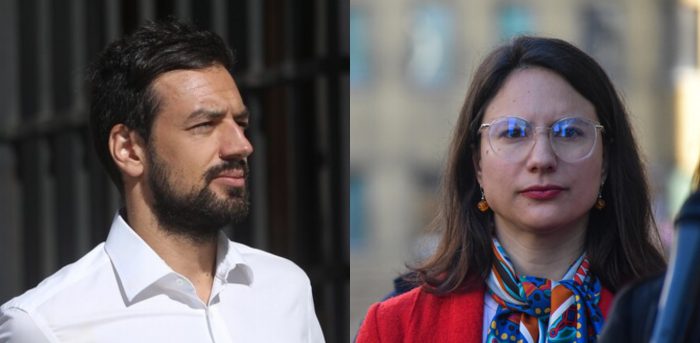
The mayor of Maipú, Tomás Vodanovic (RD), requested military support from the Government to combat the wave of crimes in his commune, causing an unexpected political scenario. Although before it was the opposition that requested this support, now even President Gabriel Boric does not rule out using the available tools, although he warned that the military is not trained to control public order.
Even the mayor of Santiago, Irací Hassler (PC), joined the request of the communal chief of Maipú, to whom it seems that “the debate that has been opened is relevant and the possibility of taking advantage of all the capabilities that the State has and particularly of a role of the Armed Forces.”
In any case, both Mayors Vodanovic and Hassler and the Government of President Boric have focused on the fact that the military deployment must be carried out in the context of the Critical Infrastructure Law, whose discussion is stalled in Congress.
“I think it is necessary that they can particularly support the protection of critical infrastructure, as well as other elements such as weapons control,” Mayor Hassler added to radio. Schedule.
For his part, the Undersecretary of Crime Prevention, Eduardo Vergara, declared on radio Cooperative that “the way to strengthen institutions in matters of crime is to strengthen the police and the evidence also shows that when countries make the decision to include the Armed Forces in public security tasks, it becomes evident that in a certain way they remove force with which the States themselves may have been empowering the police.”
Who also agreed with taking the military to the streets was the governor of the Metropolitan Region, Claudio Orrego (former DC militant), who maintained that “those who have to have the baton, the leadership in combating crime, are the Prosecutor’s Office and the police, but today they are not having all the resources they require.”
Curiously, on the contrary, the mayor of Providencia, Evelyn Matthei (UDI), opposes it, arguing that the military is not prepared for the cities and raising questions about the feasibility and legal implications of the measure. Of course, the communal chief of the eastern sector of Santiago and potential presidential candidate of Chile Vamos, affirms that if the measure is carried out it is necessary to have a clear regulation on the use of force.
Despite the altered political landscape, the request for “military to the streets” fueled the debate in the National Congress on the role of the Armed Forces in matters of internal security, and revealed the discrepancies within the ruling party regarding this sensitive issue.
For example, from the Socialist Party (PS), the senator and president of the party, Paulina Vodanovic, assured that she can understand the desperation of the mayors, but stressed that this does not enable there to be a military intervention, not only because of a legal problem, but practice.
Mayor Vodanovic’s request also called into question the historical position of the Frente Amplio, which defends that the maintenance of order and security should fall exclusively to the police forces and not the military.
In fact, users on social networks recalled that, in 2021, when the now President Gabriel Boric sought to reach La Moneda, one of the campaigns that was televised at that time was a short song that had a powerful message: “Vote Gabriel, vote Gabriel, and that the soldiers return to the barracks.”
Vodanovic qualifies his statements
Mayor Vodanovic reiterated this Thursday his request for support from the Armed Forces (FFAA) in the streets in response to the growing security crisis. However, he qualified his statements, emphasizing that this request was only an “urgent call to Congress” to accelerate a bill aimed at protecting critical infrastructure, in line with what was stated by La Moneda.
“In the face of the enormous security crisis, having the support of the Armed Forces at certain points to protect critical infrastructure with limited roles and under strict civilian control, can be one more tool that the State has at its disposal to confront this crisis,” he declared. Vodanovic. However, he stressed that this deployment will not solve the problems on its own, but is a complementary measure.
In response to the criticism and support that his request has received from both the opposition and the ruling party itself, the communal head of Maipú pointed out that the majority of mayors who face serious criminal conditions in their communes support the measure. He acknowledged that there are divergences between those in communes with low budgets and high crime rates, and those in more affluent and less conflictive areas.
It is worth mentioning that the Minister of the Interior, Carolina Tohá, warned about the escalation of crimes in Maipú and stated that with the mayor “we agree on the need to process the project” to deploy armed forces in urban areas and protect critical infrastructure. “The Government has never closed the doors,” added the Minister of Defense, Maya Fernández.
Demolition in Vicente Reyes intake
This Thursday, the intervention and demolition of 14 properties associated with illicit activities in the Vicente Reyes occupation, in Maipú, was carried out as part of an operation to address the most conflictive situations in the camp. Although one of the properties was not the target of the operation, it was demolished, but – according to Mayor Vodanovic himself – the affected family was contacted and referred to the Ministry of Social Development.
The official mayor highlighted that the main objective is the recovery of space, the eviction of homes and the relocation of affected families. The procedure was carried out with “complete success,” he said, managing to seize items used for illicit or criminal activities, and eradicating such activities from the camp.