
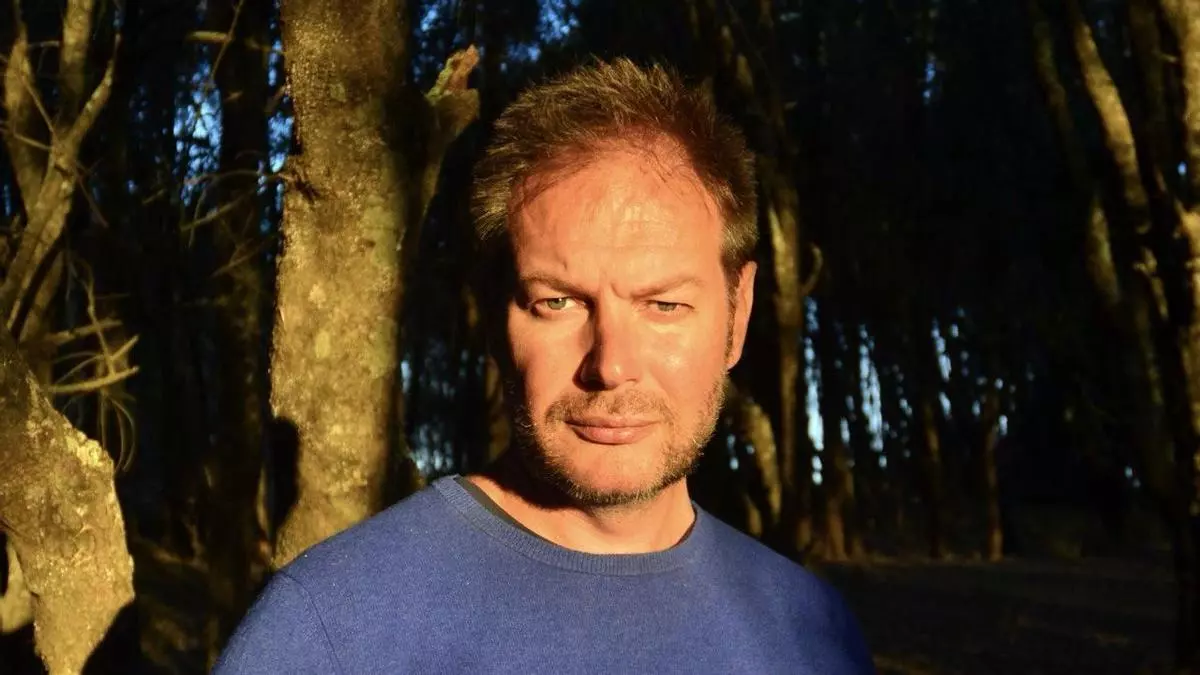
White, professor at the London School of Economics and one of the great theorists of political science, has just published ‘In the long run: The Future as a Political Idea’ (Profile Books, 2024), in which he defends not falling into fatalism.
One of the greatest victories of the system is that the slogan ‘there is no alternative’, coined by Margaret Thatcher, has become dogma. However, as the historian Johann Chapoutot writes, “all of History revolts against this idea: there is always room for maneuver, for play and for that quotient of freedom that allows us to choose.” Likewise, Jonathan White, professor at the London School of Economics, explains that “one of the main legacies of the revolutions of the 18th century was to concretely illustrate that the future is open, connecting dreams of change with practical facts.”
White, recognized by his peers as one of the great theorists of political science, has just published ‘In the long run: The Future as a Political Idea’ (Profile Books, 2024), a fascinating book about the importance of the future in the political imagination, from the Enlightenment to the present day. It highlights how, despite the serious threats that loom over humanity, such as the climate crisis, economic inequalities or artificial intelligence, it is essential to maintain the vision of long-term progress, without falling into fatalism. Otherwise, we will end up succumbing to a self-fulfilling prophecy: the end of democracy.
You argue that democracy cannot be understood without attending to the importance of the future.
We all think about the future as individuals; for example, in finding a partner, having children, facing death, etc. However, politically speaking, it is more important when the future becomes an object of collective reflection by groups, and individuals try to shape it through their participation in them. It allows us to create an imagined future that gives us the opportunity to distance ourselves from the present, offering a point of contrast and a sense of community of destiny, which is one of the foundations of politics. The future makes it possible to think of yourself as part of a group in which your problems are also the problems of others. The book explores this idea from the 18th century to the present, notable more for its non-compliance than for its observance.
One of the great contributions of liberal thought, as in Adam Smith, is that the destiny of the individual and the collective are always linked.
Classical liberal economic thought places great emphasis on the individual, his future and his interests, to legitimize capitalism. In the classical account, the market was not only defended as something that could reward individuals, either now or in the future, but also as an overall contribution to the progress of society. I think that recently the social promise of the market economy has been lost.
Because?
The consumer society encourages people to think about their personal future or that of those close to them, which causes progress to be perceived as an individual or family story, as opposed to progress as a collective story of society at large. Another factor is that we live in societies increasingly based on personal debt, which is quite individualizing.
He also points out that the precariousness of the labor market pushes towards a society of individuals and not a collective one.
In the industrial economy of the 19th and early 20th centuries it was easier for people to see their own situation reflected in those around them in the factory, facing similar conditions. In the current context of precarious and short-term employment, it becomes increasingly difficult to see yourself reflected in your peers and feel that your problems are also those of others. Political actors are needed to help with this thinking, collective movements that remind them that their problems are not theirs alone, because otherwise they tend to lose that sense of the collective future.
In his book he indicates that “democracy can survive turmoil, anguish and decline; “What he cannot resist is the expectation of an end.”
Sometimes democracy is defended as the best way to achieve good policies, prosperity, peace, etc. However, democracy is not necessarily about achieving positive things. Turmoil, anguish and decline are part of democracy and, very often, radical democracy involves challenging economic interests, the powers that be, and these have the capacity to make people’s lives worse in the short term. The survival of democracy depends on the ability to seek justice in adversity and maintain the vision of sustained long-term progress.
Despite the enormous challenges of our time, you analyze how the political class’s approach to problems as ’emergencies’, such as the climate, economic or health crisis, can end up eroding democracy
Framing problems as emergencies encourages the adoption of discretionary measures, allowing presidents to make decisions outside the framework of the parliamentary process to avoid obstacles. Governments resort to these methods because of their inability to use other means, a worrying sign, as they feel they lack authority. However, this practice can later be exploited by those who have much more dangerous intentions and take the opportunity to circumvent parliamentary processes. Therefore, there are valid reasons to resist these types of emergency solutions, even when they appear to be based on justified reasons.

The book devotes a chapter to how the Cold War established a turning point in our relationship with the future.
How do we conceive the future? In the past the different forms of anticipation of the future were visible and public. But during the Cold War we witnessed the rise of what might be called ‘secret futures’, approaches to the future that did not seek a shared vision but sought to create power imbalances. There was a marked interest in foreign policy forecasting, focused on anticipating the actions of other states, such as in nuclear deterrence, or in foreseeing in which areas the Soviet Union or NATO could concentrate their resources.
The problem arises when the “secret futures” of military foreign policy are integrated into the sphere of domestic policy.
This is seen in areas such as urban planning or protest management. Organizations originally dedicated to military planning, such as the RAND Corporation, that focused on foreign policy issues, began to influence US domestic policy during the 1960s. In doing so, they introduced a level of secrecy previously reserved for military strategy. external military in the context of domestic politics.
You argue that one of the legacies of the Cold War is conspiracy theories.
These theories, in essence, are based on the premise that certain people have advance knowledge about what is to come, that there is a select group that has access to a future that for the majority will be surprising.
In 1997, the “Operation Northwoods”, a plan proposed by the US Joint Chiefs of Staff that contemplated launching terrorist attacks against US citizens to blame Cuba and justify a war; This plan was personally vetoed by President Kennedy. You establish a connection between this event and the conspiracy theories that emerged after the attack on the Twin Towers on September 11.
Conspiracy theories about 9/11 are often based on the assumption that someone had to have anticipated the attack, raising questions such as “How could they not know?” The concept of the future plays a crucial role in these theories, linking them to events such as ‘Operation Northwoods’. A legacy of the Cold War is perceived in the use of manufactured futures to deceive and manipulate the population. I think many contemporary conspiracy theories take up this idea. In the book I explore how secrecy around the future creates a division between those with access to power and political knowledge and those who feel excluded and uninformed about their own future.
Your book has made me think about a reflection of Perry Anderson: “Diderot, Voltaire and Rousseau lived when absolutism was at its peak; none lived to see a serious change. This did not prevent them from persistently opposing the Catholic Church. “Life brings surprises.”
It is essential not to lose the ability to look beyond immediate difficulties and find motivation in the possibility of gradually overcoming them over time. This may not happen in our personal lives, but it may happen in that of an organization or group with which we identify. Formulating policies that generate immediate well-being for many people is a challenge, especially under capitalism. The greatest threat to democracy is not only these difficulties, but the possibility that in the future we will not be able to correct current injustices and that we will lose insight into the breadth and possibilities of the future.