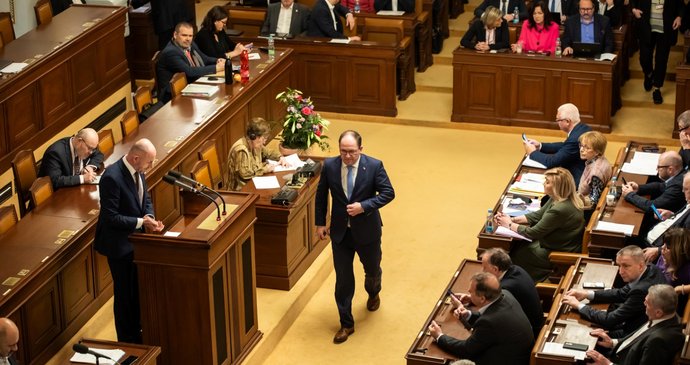
The obligation to pay insurance premiums for agreements on the execution of work from a lower limit than before is brought about by the government consolidation package approved last year. The employer’s obligation to pay insurance premiums for work transfer agreements will probably be moved from July 1 this year to January 1 next year. The deadline for employers to register these agreements remains July 1. It was approved by the House of Representatives in an amendment to the Act on Investment Companies and Investment Funds. The amendment was submitted by Minister of Labor Marian Jurečka (KDU-ČSL), his party colleague Marie Jílková and MP STAN Pavla Pivoňka Vaňková. The government consolidation package approved last year came with a much wider payment of levies for agreements. The postponement was welcomed by representatives of entrepreneurs, employers and tax advisors.
Along with postponing the effectiveness of the levies, the minister wants to simplify the system of collecting insurance premiums and the method of signing up for the levy and make it safer for the employees themselves, who work on an agreement. The records of people working under an agreement are to be kept by the Czech Social Security Administration. Jurečka has already pointed out that the system in the current legal arrangement, after debates with the professional public, turned out to be complex and with certain risks for the so-called contract holders in terms of possible arrears. There were reservations about the new arrangement from both experts and employers.
“The basic principle remains preserved – that is, at the moment when the volume for that agreement would exceed 25 percent of the average salary, then the insurance premium will be paid,” previously described by the minister. According to the consolidation package, contract work will be exempted from levies only if the earnings of one employer do not exceed 25 percent of the average wage and the earnings of all employers together do not exceed 40 percent of the average wage.
However, Jurečka’s action has provoked criticism from Alena Schillerová, the chairwoman of the ANO parliamentary club, today and earlier. She pointed out that she herself had submitted the same amendment last year during the discussion of the package. She accused the coalition of allowing the chaos.
The Chamber of Tax Advisors and other organizations stated in today’s press release that according to the approved proposal, the limit from which social and health insurance will be deducted will be reduced to 4,000 crowns for all work performance agreements. “In addition, the employee has the opportunity to determine one main, so-called notified agreement each month, in which the limit for social and health insurance would basically remain at the current amount, i.e. 25 percent of the average salary,” they describe The employer will be able to check online whether another employer has already announced such an agreement. In such a case, the higher limit would apply to the employer who announced the agreement earlier.
Today, at the suggestion of ODS MP Libor Turk, the House of Representatives, among other things, clarified the provision that exempts money from the sale of real estate from income tax if the taxpayer uses it to secure his housing needs. These are mainly cases where the taxpayer owned the property for less than ten years. According to the law, they must announce their acquisition by the end of the deadline for submitting the tax return. According to Deputy Turk, there are cases where the taxpayer does not report in time that he used the money to secure housing needs. He must then pay additional tax including penalty and interest. The deputy therefore proposed that in such a case the taxpayer should pay a fine for non-fulfilment of a non-monetary obligation according to the tax code, but there would be no risk of additional taxation.
According to the amendment, the counties, as the owners of the majority of archaeological finds, could adjust the requirements for their processing and documentation as well as the method of their handover. They will be able to control organizations that conduct research in their territory.
Debt relief is one of the options for solving bankruptcy. The coalition government proposed, in accordance with its program, to shorten the process from the current five years to three years for all borrowers. The changes to the Insolvency Act are based on a European directive, which, however, requires a three-year process only for entrepreneurs. Since the changes, the government promises to make debt relief available to a wider range of entrepreneurs and consumers. The amendment is particularly criticized by members of the opposition ANO movement. They are worried about the deterioration of the position of creditors, especially, for example, associations of unit owners, housing cooperatives or single parents in the case of alimony owed.
The program also includes drafts in the opening round. It is about adjusting disciplinary proceedings with judges, prosecutors and executors and introducing rules for lobbying. It is not certain whether the deputies will get to it.