

A letter changes the concept of time, becoming a haven that upsets all predictions, particularly because it defies oblivion, and it is precisely this tacit correspondence that is the tool that memory has to make itself present and return again and again to each word loaded with feeling, in a systematic plastic exercise that often seems to be utopian and that runs out at the end point.
However, this extensive journey is evidence of an epistolary relationship, in which shared moments and experiences are reconfigured through creative letters, which ultimately determine this “Communication at a distance”, the name that gives its name to the exhibition at the Centro Nacional de Arte Cerrillos (CNAC) between the Chilean and Argentine artists Guillermo Deisler (Chile 1940-Germany 1995) and Edgardo Antonio Vigo (La Plata- Argentina 1928-1997).
They carried out a vast conceptual and editorial graphic work, with cards, prints, collages, stamps, through which they denounced the atrocities of the dictatorships they lived through, and which also motivated them to generate “mail art”, which gave relevance to art by mail, maintaining an artistic link for almost three decades. Intertwining their careers around a fight against impunity, human rights and exile that radically changed their lives.
In this sense, the notion of correspondence implies establishing a dialogue beyond writing, which entails a proximity originating in distance. This argument is shared by the Argentine writer, Ricardo Piglia, when he states that “correspondence is a perverse genre: it needs distance and absence to prosper.”
With that, it must be understood that this exhibition originates from a joint action as an act of subversion, against the intention of “uprooting” and against estrangement, given that this action or effect of estrangement is minimized by the determination of these two artists and the notion of trans-Andean exchanges. Especially because they make mail a participatory art object, which drives away forced estrangement.
Taking advantage of the fact that information travels on a human scale, and both of them -do their thing- and I emphasize this, because they continued expanding their art, and with more desire.
An action that is expressed in an observation by Soledad Novoa Donoso, director of (CNAC): “The deep and systematic work of the curators (Silvia Dolinko and Pamela Navarro Carreño), who give us the unique opportunity to see not only works, but also the models of books, magazines, postcards, stamps and objects that make up the imaginary universe of both artists, activated with experimental, graphic and poetic work”. A work that, by the way, complements the previous exhibition held in 2023, at the Matta Cultural Center of the Chilean Embassy in the neighboring country.
Furthermore, the interesting thing about “Communication at a Distance” is that it is not limited exclusively to projecting its works, but rather to highlighting the work of various artists from both Latin America and Europe, since Deisler and Vigo promoted and supported the publication of various collective projects, which can be seen in the thirty-eight editions. Universe by Deisler, and the three volumes of the International Bookplus the twenty of Book of stamps and postmarks from Vigo.
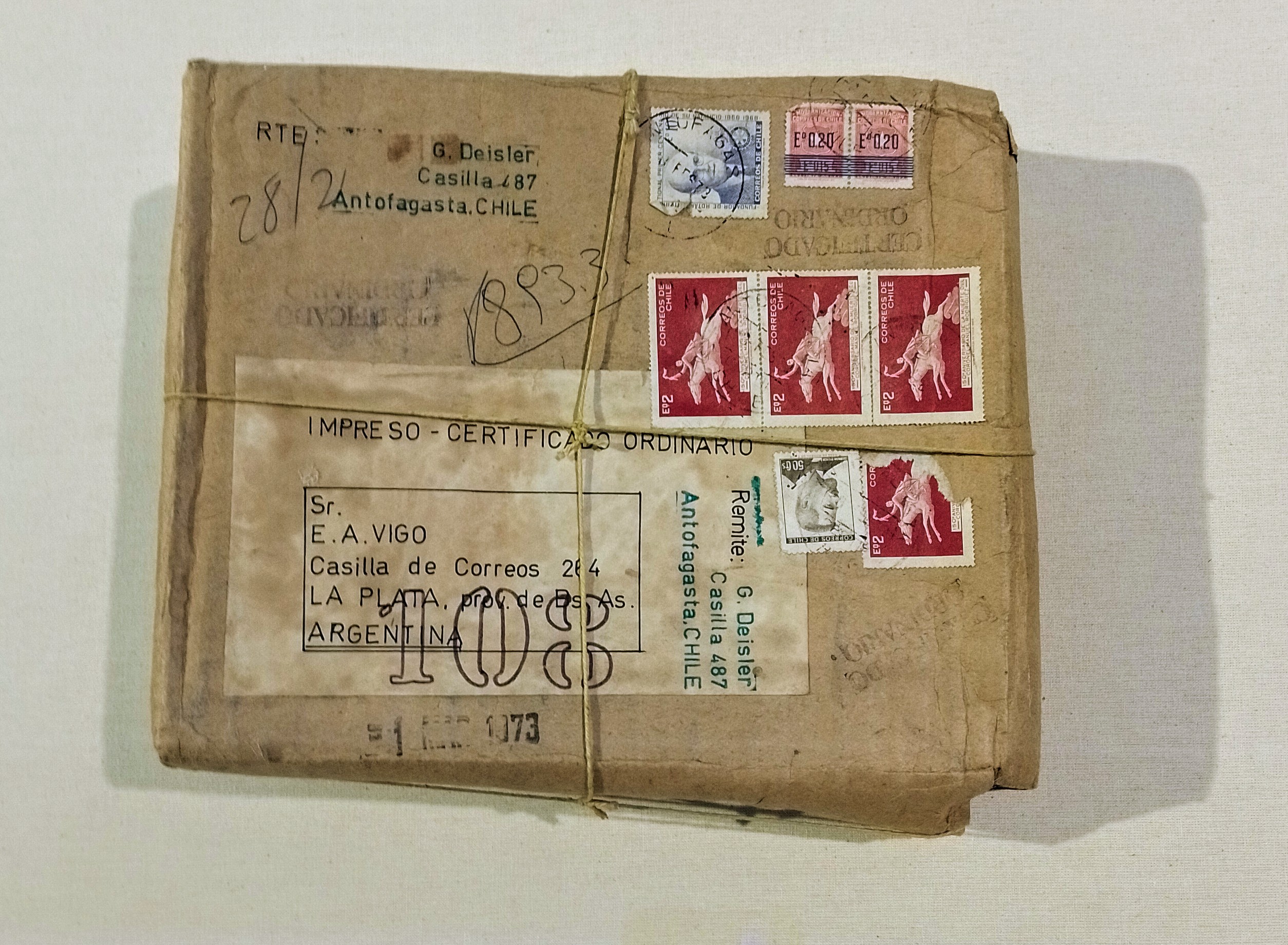
Thus, this creative epistolary formula ends up being a representation of resistance, in which an artistic friendship prevails first, expressed in Vigo’s maxim or visual poem: “Sow memory so that oblivion does not grow.”
Something that is demonstrated in “Guillermo Deisler and Edgardo Antonio Vigo/Communication at a Distance”, an exhibition project that began on August 10 at the Centro Nacional de Arte Cerrillos (CNAC), and continued on the 24th of the same month with “Redes Gráficas”, at the Museum of Contemporary Art (MAC- Parque Forestal), showing woodcuts, lithographs, collages and books made by both artists, who traced a joint route with which they shortened the distance, leaving oblivion behind.
That is why Isabel Allende’s words serve to demonstrate this – “death does not exist, people only die when they are forgotten; if you can remember me, I will always be with you” – and I am not just talking about nostalgia, or the disquisitions that can be perceived in the course of a visual story that, in addition to complicity, includes a universal vision of art in which mail art translates into a liberating action, in which no form of expression or representation is excluded.
-
The content expressed in this opinion column is the sole responsibility of its author, and does not necessarily reflect the editorial line or position of The Counter.