
The Frenchman Paul Gauguin wrote at the beginning of his book “Nua Nua: Memoirs of Tahiti”: Tell me what you saw?
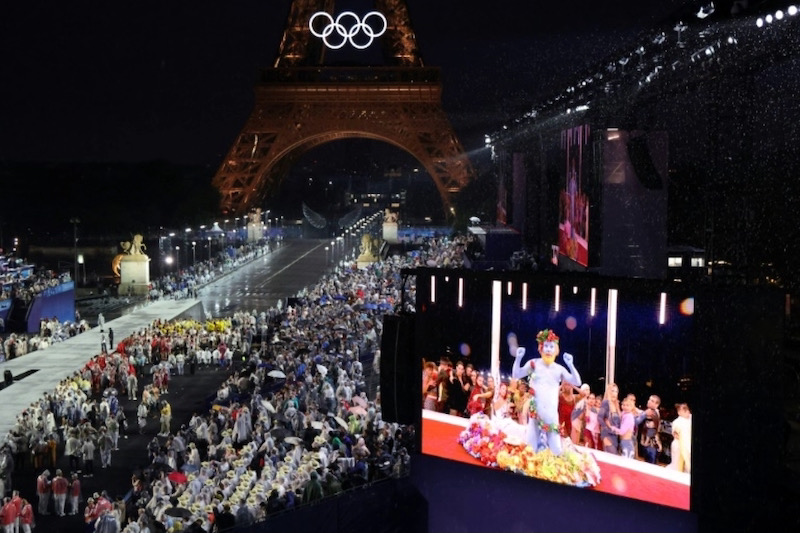
At the opening of the Paris 2024 Olympic Games, I saw the following: paintings on the water, boats, flags of colorful countries, athletes in clothes from different cultures, a moving circus in the floating gardens of Versailles, musical and singing performances, statues from paintings, and a sensual scenography that is significant, such as the Last Supper before the betrayal, a musician and a singer on a small floating island lit by a torch played with by the wind in the middle of the river, what poetry… an audience on bridges and on the sidewalk, and behind it gardens that appear their captivating greenery at night…
To expand the eye-catching frame, balloons flew over Paris, allowing the TV director to show the grandeur of the city from above. This would allow every viewer to compare the village he lives in with the city of Paris, which hosts millions of tourists in a single day and has no water, electricity, bread or internet.
In all this, I saw raindrops on the focus of dozens of cameras that transmit the scenes to millions of screens in all countries of the world.
Who prepared this that I saw?
It was prepared by a young theatre director who worked on the artistic direction of the various opening shows and presented to the world by a television director who transmitted it to the world’s screens from a theatre with an open roof extending six kilometres.
Theatre director Thomas Jolly (1982) directed an 18-hour production of William Shakespeare’s Henry VI. Television director Simon Staffurth has broadcast four previous Olympic Games and filmed the coronation of King Charles in London. A director who knows how to handle the camera, a master of the medium.
It is clear that the crew supervising the ceremony is professional, and has an artistic achievement that gives it the legitimacy to undertake a major task. It is a crew that has at its disposal amazing logistical resources. The day after the ceremony, Radio France Internationale hosted some members of the opening preparation team (writers, musicians, scenographers, and choreographers) who worked for a year and a half and had three thousand costumes for the actors… and 12 sets for a pharaonic show.
Twenty-four hours before the opening of the Paris 2024 Summer Olympics, French media bragged about the logistics and aesthetics of the venue.
French channels tell the world that the opening will be on a river, not in a stadium… 205 state parades will take place in a ceremony that will last about four hours, with the participation of 6,000 athletes and 1,000 artists supported by 45,000 volunteers. The parade will end at the Eiffel Tower, where the promise of Celine Dion singing on the opening platform may come true (the organizers deliberately kept it ambiguous to create surprise), where 100 heads of state will be guarded by 45,000 policemen; including 1,800 foreign policemen…
This is a massive logistical feat that reveals the French state’s readiness to rise to the challenge. Before the river parade, the mayor of Paris swam in the Seine to assure viewers around the world that the river is clean, after spending more than a billion dollars to clean it of pollution.
French President Emmanuel Macron was welcoming the representatives of the countries on the red carpet. The age of the guests, the dress and the way they greet each other revealed a lot about the people of the participating countries. For the Moroccans, the opening was the victory over the Argentine national team on 24-07-2024.
The opening of the World Games has become an event that combines art, sport and geostrategic positioning. Chinese Zhang Yimou directed the opening of the Beijing 2008 Olympic Games, actors Morgan Freeman and Ghanem El Moftah chronicled the opening of the Qatar World Cup, and Celine Dion (Canadian), Carl Lewis (American), Lady Gaga (English) and Zinedine Zidane (French-Algerian) made the event in Paris. Demographic globalization at its most extreme.
After Lady Gaga, who starred in the movie “A Star Is Born,” and Celine Dion, who made Titanic viewers cry, sang, the French president declared the opening of the Olympics of Modern Times.
What does what I saw indicate?
It shows the greatness of French art. This is a display befitting the capital of visual arts in the last five centuries, since King Francis I brought the Mona Lisa from Italy and invited its owner, the artist Leonardo da Vinci, to live in France in 1516; he even appointed him as the chief painter, engineer and architect and their teacher.
This is an artistic heritage. Da Vinci was an artist, not a priest. He died in the hands of a king.
To reveal this artistic glory, the French organizers had an obsession: What was the image of France in the nineteenth century? And what is it like at the beginning of the twenty-first century?
How can I present the best photos of my city and country?
The river parade started from the Bastille and reached the Eiffel Tower. Paris and its river tell history. The parade was a journey through time. The pictures and videos spread on the web speak for themselves… so this article will be devoted to explanation and commentary.
The river show began with a boat carrying a team of Greek polytheistic game inventors, a team riding a boat called Don Juan (this is the title of a film directed by Alan Crosland 1926 and many versions of which were released, the latest in 2022). Added to this emotional hero are scenes of the city of seduction that granted freedom to women early on… The director of the show recalled Da Vinci’s painting The Last Supper and reminded the viewers of it in a special way.
The opening is a grandiose show, propaganda, drawing, collage colors, masks… Scenography, that is, the art of decorating the stage and the decor with drawing… live decorations… live images that pronounce the word, as the Frenchman Gilbert Durand wrote in his book “The Symbolic Imagination.” He said: “The image is the presence of the thing in its bones and flesh before perception” p. 5.
Images are embodied, so the opening ceremony displayed the characters from the books that marked the history of Paris in embodied form. The Seine River was furnished with paintings and themes of the values of the French Revolution that changed the modern era. Then the opening displayed the values of freedom, equality, fraternity, celebration and sport… embodied. There is no place for abstraction in the Parisian shows designed by the young director.
Director Thomas Joly positioned his characters so that they were isolated and visible on a six-kilometre long, colourful, rectangular stage to create a delight for the eye. The characters (actors) knew where the camera was pointing to, communicating with a billion viewers who were experiencing the summer heat and watching a summer show in the rain… which threatened to make the artists slip.
Director Thomas Joly worked on a visual scenic organization for the show, sifting through the history of France to preserve the significant moments with the aim of surprising the viewer. It is clear that rehearsals were organized and the actors were directed to embody the historical characters they play in order to be understood. There is no room for improvisation in scenography that addresses the eye. Therefore, the phrase graph is repeated in all show professions: photography, cinematography, scenography, choreography… This is in everything related to what is presented to the eye, as in writing before the letter hieroglyph). For reference, scenography is “the transformation of the novel genre into a cinematic genre with a design architecture (kinetic – dialogue – quotation) that is concerned with the idea, image and technique” (Unified Dictionary of Contemporary Literary Terms 40. Arab League Educational, Cultural and Scientific Organization. Arabization Coordination Office. 2015 Al-Amniya Press, Rabat 2015. p. 135). This was evident in the scene of the execution of the queen who did not pay attention to the hunger of her people…
This is a narrative of the history of France, spread out on the Seine, containing selected, significant passages, both ancient and contemporary.
Right-wing politics and verse
Here is a contemporary example of the participants on the stage: the singer Aya Nakamura took the stage to sing at the opening, after being rejected by the French far right because she is black and Malian and does not sing in proper French; therefore, she does not represent France. According to Marine Le Pen of the National Rally party, Aya Nakamura insults France; however, the singer has a huge following in the globalist party on Instagram and TikTok. Therefore, the organizers considered that Aya Nakamura represents France, despite her accent and skin color… Aya Nakamura walked with her exceptional body on the opening stage in the heart of Paris, making a defiant gesture at the camera retreating in Traveling.
This is a small example of the casting backgrounds of the artists and personalities participating in the opening. We can add the presence of Zinedine Zidane, who aspires to coach the French national team; but there are those who object.
In conclusion, the opening has glorified the diversity of French identity, culturally, ethnically and sexually. This will provide a topic of debate that supports the extension of media coverage. Many will admire the city’s architecture and reject its values, while they do not like their own cities.
This is nothing new, wrote a reactionary poet: “Paris is the city of evil and the modern equivalent of the biblical Babylon.” Rainer Maria Rilke, The Book of Hours, p. 58.
#Cinematographic #opening #Paris #Olympics. #grandeur #city #splendor #show
2024-08-03 02:45:25
#Cinematographic #opening #Paris #Olympics. #grandeur #city #splendor #show
2024-08-03 02:45:26