
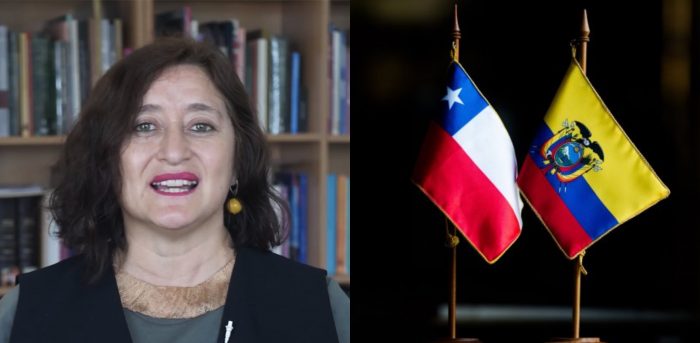
President Gabriel Boric announced this Thursday the new ambassadors of Chile in Ecuador, Croatia, Greece and Guyana. In this context, the designation of Carola Muñoz as the new ambassador in Ecuador, who had previously been removed from her position in the Ministry of Foreign Affairs (Minrel) after the leak of a controversial audio in relation to the discussion, caused surprise among the authorities. of the continental shelf with Argentina.
It was in March of last year, when the Minrel completed the removal of the chief of staff of former Minister Antonia Urrejola, Carola Muñoz, and transferred her to the Division of Cultures, Arts, Heritage and Public Diplomacy of the Chancellery. where he served since April 2023.
The change occurred after the controversy generated by the leak from the Foreign Ministry itself of an audio of a private meeting, where they spoke, in an informal tone, regarding various national and international authorities. This earned Urrejola numerous criticisms, who at that time decided to resign from his position.
Today, with the political scientist and diplomat Alberto van Klaveren in charge of the portfolio, and in consideration of this background, the deputies of the Foreign Relations Commission, Catalina Del Real and Stephan Schubert (both from the Republican Party bench), criticized the designation of Muñoz, pointing out that it would be a “consolation prize.” Meanwhile, from the UDI, they also regretted the rotation of positions within the Government.
“There is a cast problem here”
“President Gabriel Boric definitely has a serious problem in appointing people to represent our country abroad who do not always have a reason why they should not have been appointed. He has just appointed journalist Muñoz as ambassador to Ecuador. In circumstances that she was the former chancellor’s chief of staff and that she was removed from that position in the embarrassing episode of the leak that occurred from a conversation from the Chancellery to the press,” Schubert said.
Along the same lines, the parliamentarian criticized that “despite that, despite the leak, despite what happened, the President gives him as a reward to be the representative of Chile in Ecuador. There is a cast problem here. Apparently the President does not have better people and no longer knows who else to put in such relevant embassies.”
For her part, Representative Del Real stated that “in a kind of consolation prize, the President appoints as ambassador to Ecuador the former chief of staff of former Minister Urrejola, Carola Muñoz, who was removed from her position for being involved in the “case of the audio that was leaked to the press from the Ministry of Foreign Affairs.”
“I believe that people who did not perform well cannot be chosen to represent our country abroad, especially considering the delicate situation that Ecuador faces due to the wave of violence. “Apparently it is a common practice for the President to rotate positions, instead of looking for people who are really suitable to carry them out,” concluded the congresswoman from the Republican bench.
Deputy Christian Moreira (UDI), also a member of the aforementioned commission, stated that “the decision that the government has taken with the appointment of Carola Muñoz is very unfortunate, a person who was involved in serious events because audios were leaked. unauthorized to the media.”
“He has a diplomatic career”
“There is no impediment for Ambassador Muñoz, a career diplomat, to be appointed in Ecuador,” they said from the Foreign Ministry.
From the ruling party, meanwhile, as stated Thirdthe president of the Foreign Relations Commission of the Chamber, Tomás De Rementería (PS), pointed out that she “has all the credentials” for the position.
The socialist parliamentarian maintained that Muñoz “has a diplomatic career but also an important political role, and the fact that she has participated in something where a journalist leaked a private conversation, it seems to me that does not disqualify her for that. She had a diplomatic career, she is a person who has been in various spheres and I believe that she has all the capabilities and faculties to be the position that was assigned to her.”
Furthermore, De Rementería expressed that the President has the autonomy to appoint embassies without being questioned. This same point was supported by deputy Marcos Ilabaca (PS), who maintained that “the new ambassador had no responsibility in the events that involved the leak of the audios that ended with the departure of former Foreign Minister Urrejola. Therefore I do not see any type of valid questioning of this designation.”
Muñoz is a journalist from the University of Chile and a graduate of the Andrés Bello Diplomatic Academy. She has worked in the Chilean Mission to the OAS, in the Chilean Embassy in Peru and in the Mission to International Organizations in Geneva.
It is worth mentioning that, yesterday, the minister of the General Secretariat of Government (Segegob), Camila Vallejo, responded to the president of Ecuador, Daniel Noboa, who recommended that Gabriel Boric “make the difficult decisions now” in the face of the security crisis in Chile. “We continue to make difficult decisions because we do not want violence and organized crime to reach levels like the neighboring country, the country of Ecuador, has unfortunately reached, and we are working in that direction.”
Furthermore, this is not the first time that President Boric’s appointments have generated criticism from the opposition. It also happened when Bárbara Figueroa in Argentina or Beatriz Sánchez in Mexico were nominated.
Complex situation in Ecuador
Carola Muñoz will not have it easy. A wave of violence linked to drug gangs has transformed Ecuador from a peaceful tourist destination to a key player in the global narcotics trade.
In the first days of January, the Andean country experienced the live kidnapping of television journalists at gunpoint, a prosecutor shot dead, the takeover of a hospital, bomb threats and prison staff taken hostage by inmates after a notorious criminal disappeared from his cell.
President Daniel Noboa declared a state of emergency and told the BBC that the nation was “fighting every day not to become a narco-state.”