
‘Jogi Colony’ located in the town of Waharu in Umarkot district of Sindh is considered to be the largest settlement of spiders in the province. Every house in this colony must have some kind of snake.
Despite the modern age, the residents here are teaching their children their family spider work instead of traditional education to continue the association with the ‘family jog’ i.e. the spider snake.
Jogi Colony is named after its Mukhya Ustad Misri Jogi by the residents here, who passed away recently. Now in his place, his son Juman guides the jogis of the fakir basti.
In a conversation with Independent Urdu, Juman Faqir Jogi said that this work is not his business but a generational tradition. ‘This work no longer earns money, but we are still teaching our new generation to do the traditional work of spere so that this family jog goes on.’
The Jogis living in Punjab and North Sindh are Muslims, but the inhabitants of this settlement of Umarkot are Hindus.
According to Juman Faqir Jogi, he belongs to the Gurnari Jogi tribe, which Shah Abdul Latif Bhatai has also sung in his poetry. This tribe is considered to be a major tribe of Jogis living in Sindh. Gurnari Jogis wear large earrings in their ears and are highly skilled at identifying and catching snakes.
According to Jaman Faqir Jogi: ‘We feed snake meat to our new-born boys in sutti (the first food given to the baby), which makes him a traditional Gurnari Jogi and makes him smell the scent of the snake and see the line of the snake. It is also recognized by doing.’
The Jogis are basically a nomadic tribe, who travel from place to place with snakes and tell people their fortunes by showing them snake dances on beans, for which people reward them with cash. Give money.
Apart from this, Jogi Gedard also sells Sanghi, Manna or Zehar Muhra. According to the Jogis, mana or poison seal comes out of the snake’s mouth and by placing the seal on the place where the snake bites, it absorbs all the poison.
To settle these Jogis, in the 1970s, the then Prime Minister Zulfikar Ali Bhutto allotted a government plot at Daru in Umarkot so that the Jogis could settle there.
Explaining the types of black snake, Juman Jogi said that there are four different types of this snake. The first type is called Padma snake, which has both belly and back completely black and has four distinct dark black markings on its fangs.
According to Juman, these marks are the footprints of Hazrat Ali’s horse and this is the identity of this snake.
He further said that another type of black snake is called Gada snake or Tlihar snake, which has a completely white belly and black back. Similarly, the third type of black snake is called broad snake. This snake is also black like other black snakes, but its distinguishing feature is that it has white markings all over its body.
According to Juman, the fourth type of black snake is Shesh snake and Jogi calls this snake the king of snakes. This snake is hard to find.
Jaman said that a baby rattlesnake does not become a rattlesnake as soon as it hatches, but it takes at least 100 years to become a full-fledged rattlesnake.
Majority of the population of this Jogi tribe living with snakes resides in different villages of Umarkot district.
This section contains related reference points (Related Nodes field).
Juman Jogi said about the mana of snakes that ‘mana is not found in every black snake, this mana is found only in the black snake. Padma, the manna in the Talheer wide snake cannot be called manna, it is called poison mora and this poison mora is present in every black snake.’
He explains that ‘when the snakes are underground for the four winter months, they go deep into the ground to avoid the winter and during this time do not come out of their burrows. During these four months, the snakes only eat soil in the ground, this soil constantly sticks to the palate above the snake’s tongue, and on this sticky soil, its venom is poisoned by the globule. That soil continues to absorb this poison and then gradually that soil ceases to be soil but becomes a piece of poison. The same piece of poison is then called Jogi Zehar Mora.’
Juman further states that the snakes mate during the month of Sawan, before which each snake vomits. In this vomiting he throws out of his mouth the poison moray, which the Jogis fetch from the forest.
He further said that another way of obtaining poison mora is that after catching a snake, the Jogis see that if there is poison mora in the mouth of the snake, then the Jogis make the snake vomit in various ways to remove it from the mouth, which For that, they feed the snake three times with the herb. This causes the snake to vomit and the venom comes out and falls.
This poison is of great use and value to the Mora Jogi. If someone is bitten by a snake, they keep the poison on the bitten place. It absorbs all the venom of the stinger. Jogis say that no other snake except the black snake has mana or venom.
Jogis don’t tell everyone how to catch a snake, but Juman Jogi says that to catch a snake, you have to follow its line. From the line of the snake on the sand, they know which way the snake has gone, whereas no ordinary person except the Jogi can tell from the line whether it is the line of a snake or of some other insect.
According to Jamin Jogi, the Jogi first recognizes the line of the snake and then looks at the line carefully. If the line is crooked on the sand dune, they know that the snake went up the sand dune, and if the line is perfectly straight on the sand dune, they know that the snake went down the dune. . Also, the tail mark on the line helps guide them in the direction of the snake from the line.
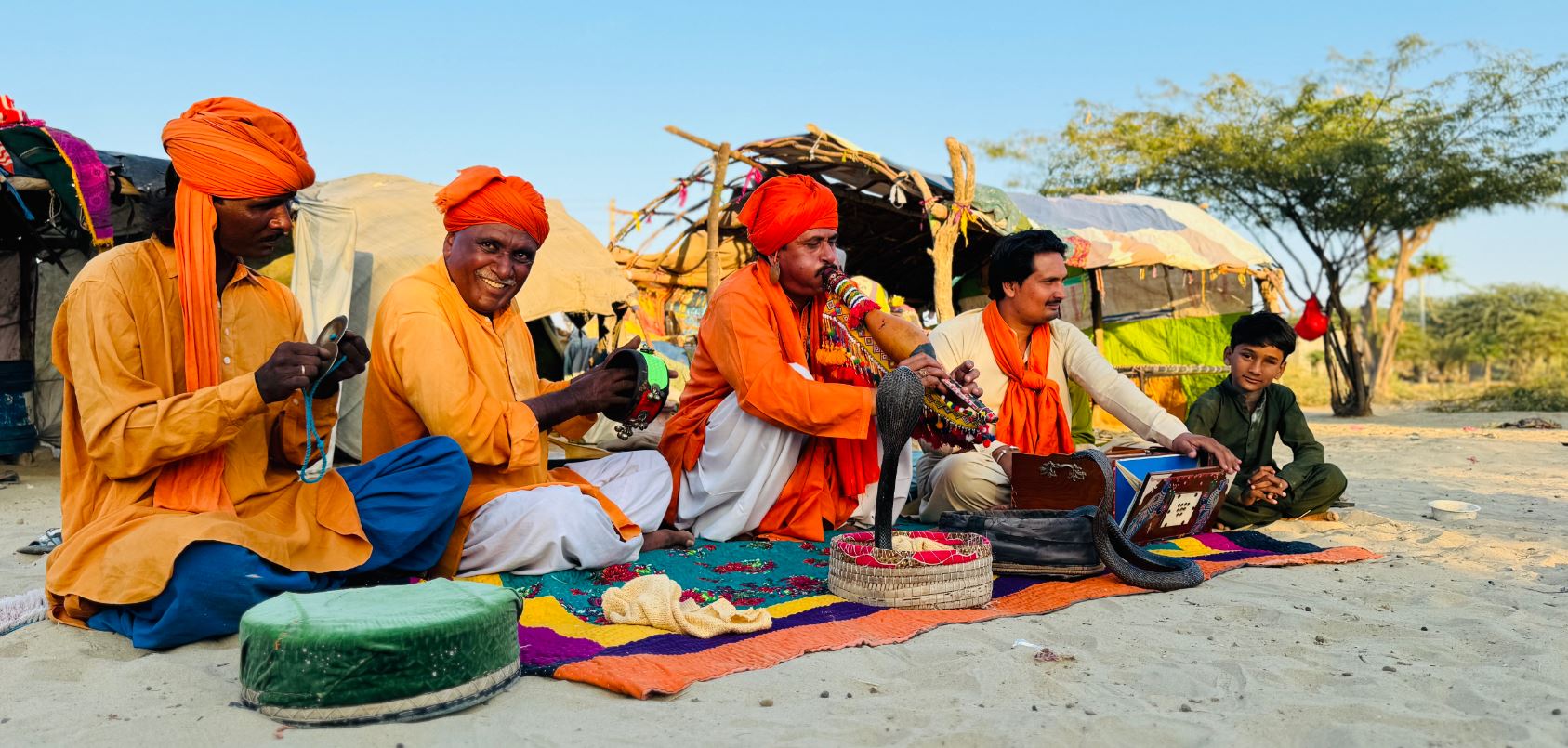
Juman Faqir Jogi (middle) said that snake catching is not his business but a generational tradition (Khalid Kumhar).
Jogis can also guess the direction of the snake from the thorns and the garbage, which side the garbage is removed from. Similarly, it is difficult to judge from the line of a snake on rocky ground, but the Jogis can guess even from that.
Juman Faqir Jogi told Independent Urdu: ‘When a Jogi catches a snake, he catches it by the head very skillfully, so he cannot bite it. After catching it, the Jogis remove its venom or poisonous fangs. Jogis believe that black snakes have fine holes in their teeth. Its venom enters the body of the bitten through these holes.
‘Snake venom is present on both sides near the snake’s tongue, this venomous part is called Jogi Venom Gutti. To get to this poison Goti, the poison passes through a Naard, which the Jogis call Naard Goti in their language.’
Jogi says that when any black snake moves a little after biting, this narad goti is again filled with poison, so after biting one, the snake can bite the other at the same time, so catching the snake is very difficult. Then the Jogi first removes both the naard gutti and the venomous gutti of this snake, after removing both of them, the snake is not able to bite anyone.
Jogis consider the black snake as an important part of their household after catching it. They sleep this snake with them at night. It is fed with milk from the bone of a goat, called meat, and is also fed with mud, which is also known as multani mitti.
Apart from black snakes, there are many other species of snakes, one of which the Jogis call ‘Lundi Bula’. The second type is called ‘pien bla’. Which in Thar is generally called Bachhari (Bare), but in some places it is also called ‘Fukni Bala’. Apart from this there are mare, bhoghi and many other species.
There is a custom among these Jogis that they do not marry a young man until he has learned to catch snakes. It is because of this ritual that every Jogi first teaches his child to catch a snake. By the way, Jogis give their daughters a hunting dog, a jackal, etc. as dowry, but they never forget to give them a black snake.
Now some Jogi boys are also studying in universities, who do not know how to catch snakes, but still a large majority of Jogis do snake catching.
For authentic news and current affairs analysis join Independent Urdu’s WhatsApp channel Here Click
#Abode #spiders #Umarkot #dont #learn #catch #snakes #wont #married
2024-04-27 20:20:02